
Jikan Nazo Review: Is It Worth Your Time?
If you’ve been searching for an honest Jikan Nazo review before spending your money, you’re in the right place. This breakdown is for puzzle game fans, casual players curious about time-based mechanics, and anyone who wants to know if Jikan Nazo is worth buying before hitting that purchase button.
We’ll walk through what the gameplay actually feels like day-to-day, break down the standout Jikan Nazo features that separate it from other best time puzzle games on the market, and give you a straight look at the pricing so you can decide if the value makes sense for you.
No fluff, no hype — just what you need to know.
What Is Jikan Nazo and Who Is It For
Overview of the Game Concept and Core Mechanics
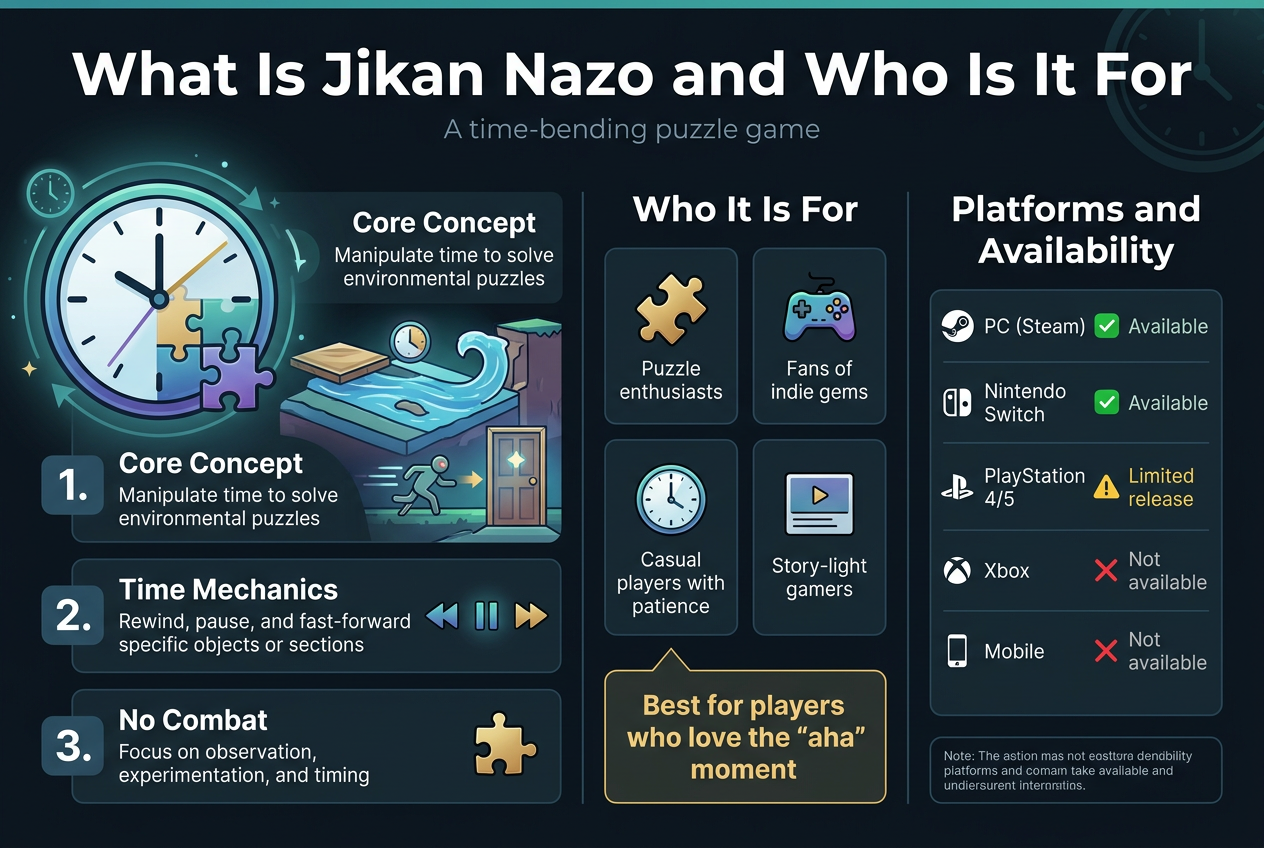
Jikan Nazo is a time-bending puzzle game built around a deceptively simple idea: manipulate time to solve increasingly complex environmental challenges. The name itself translates roughly to “time mystery” in Japanese, which perfectly captures the spirit of the experience.
At its core, players control a character who can rewind, pause, and fast-forward specific objects or sections of the environment — not the entire world. That distinction matters. You might rewind a platform while a water current keeps flowing, or freeze a moving enemy while a door continues opening. The layered timing mechanics create puzzles that feel genuinely fresh, not just recycled platformer logic with a new coat of paint.
There’s no combat. The entire game revolves around observation, experimentation, and timing. Expect to fail often — and learn something new each time you do.
Target Audience and Ideal Player Profile
Jikan Nazo isn’t designed for everyone, and that’s actually a strength. It targets a specific kind of player:
- Puzzle enthusiasts who enjoy slow-burn, logic-driven challenges over action
- Fans of indie gems like Baba Is You, The Witness, or Manifold Garden
- Casual players with patience — the difficulty curve is real, but fair
- Story-light gamers who prefer atmosphere and gameplay over heavy narrative
If you’re hunting for a fast-paced experience or a game you can fully enjoy in autopilot mode, this probably isn’t your match. But if you love that satisfying “aha” moment after staring at a puzzle for ten minutes, Jikan Nazo was basically made for you.
It also works well as a beginner guide into time-mechanic puzzle games — complex enough to challenge newcomers, but not so punishing that it feels inaccessible.


Platforms and Availability
| Platform | Availability |
|---|---|
| PC (Steam) | ✅ Available |
| Nintendo Switch | ✅ Available |
| PlayStation 4/5 | ⚠️ Limited release |
| Xbox | ❌ Not available |
| Mobile | ❌ Not available |
The PC version on Steam is the most polished and recommended entry point, especially for players who want access to community-made levels and updates. The Switch port holds up well for handheld play, making it a solid pick for puzzle sessions on the go.
Key Features That Set Jikan Nazo Apart
Unique Time-Based Puzzle Mechanics
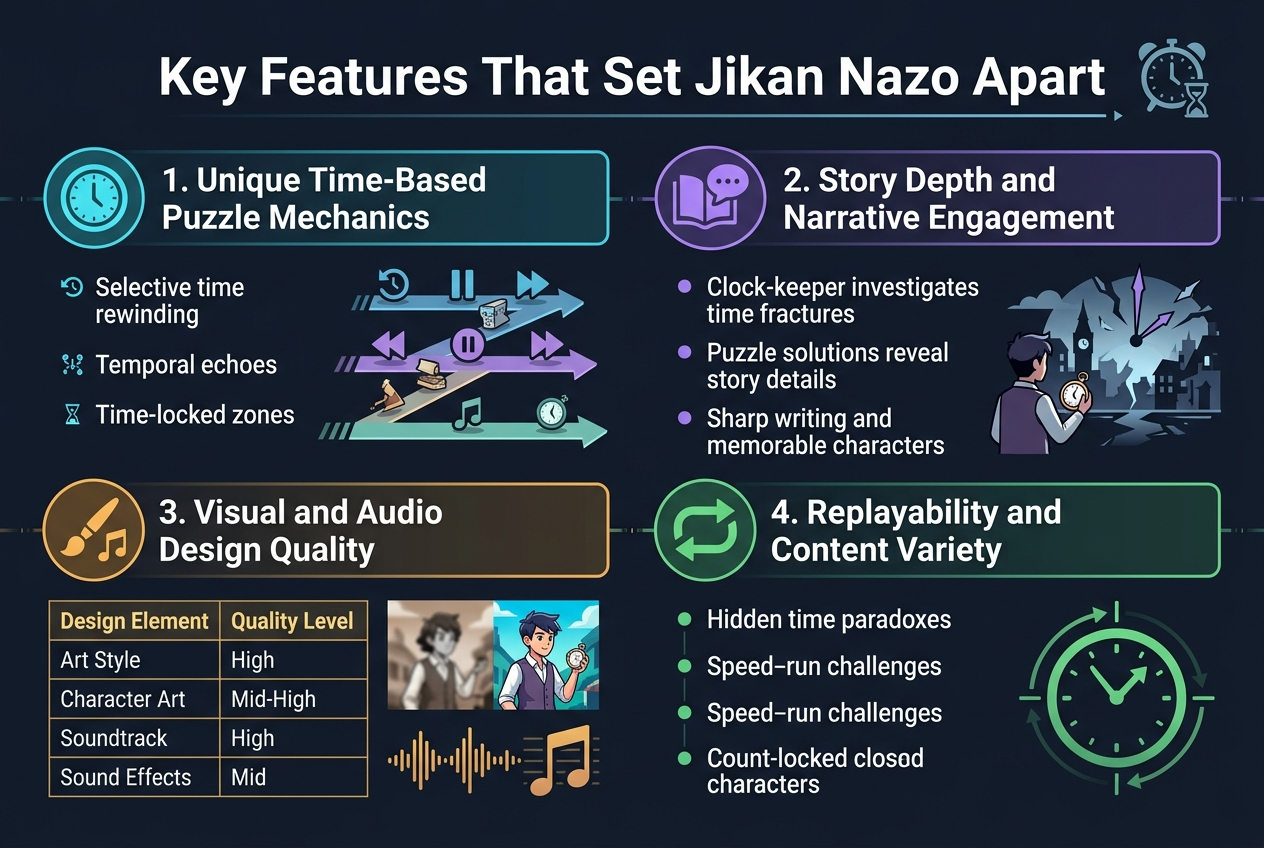
Jikan Nazo builds its entire identity around time manipulation, and it does this in ways most puzzle games don’t even attempt. Players can rewind, pause, and fast-forward elements within each puzzle independently — meaning you’re not just controlling time globally, but managing multiple timelines at once. This creates layered challenges that feel genuinely fresh, even if you’ve played other time puzzle games before.
Key mechanics include:
- Selective time rewinding on individual objects
- Temporal echoes — ghosts of past actions that interact with the present
- Time-locked zones where certain rules apply only within specific windows
Story Depth and Narrative Engagement
The story hooks you faster than expected. You play as a clock-keeper investigating anomalies in a town where time keeps fracturing. The narrative isn’t just window dressing — puzzle solutions often tie directly into story revelations, which makes solving them feel genuinely meaningful.
The writing avoids being overly cryptic or pretentious. Characters are memorable, dialogue is sharp, and the pacing keeps things moving without rushing through emotional beats. For a puzzle game, that’s a harder balance to strike than it sounds.
Visual and Audio Design Quality
Visually, Jikan Nazo goes for a hand-painted aesthetic with shifting color palettes that reflect the current time state. Past moments appear desaturated and slightly blurred; the present is vivid and sharp. It’s not just pretty — it’s functional visual storytelling.
| Design Element | Quality Level | Notable Feature |
|---|---|---|
| Art Style | High | Dynamic time-state color shifts |
| Character Art | Mid-High | Expressive, consistent design |
| Soundtrack | High | Adaptive audio tied to timeline |
| Sound Effects | Mid | Clean, non-intrusive |
The adaptive soundtrack is a standout — music layers in and out depending on which timeline you’re manipulating, which sounds gimmicky but actually enhances immersion significantly.
Replayability and Content Variety
Jikan Nazo holds up beyond a single playthrough better than most games in this genre. Here’s why:
- Hidden time paradoxes scattered across levels unlock bonus content
- Speed-run challenges with leaderboard integration
- Alternate endings tied to choices made during specific puzzles
- New Game+ introduces additional time variables that reshape familiar puzzles
If you’re evaluating whether Jikan Nazo is worth buying for long-term value, the content variety alone justifies serious consideration — especially for players who enjoy optimizing puzzle solutions rather than just completing them.
Gameplay Experience Breakdown
Learning Curve and Ease of Entry for New Players
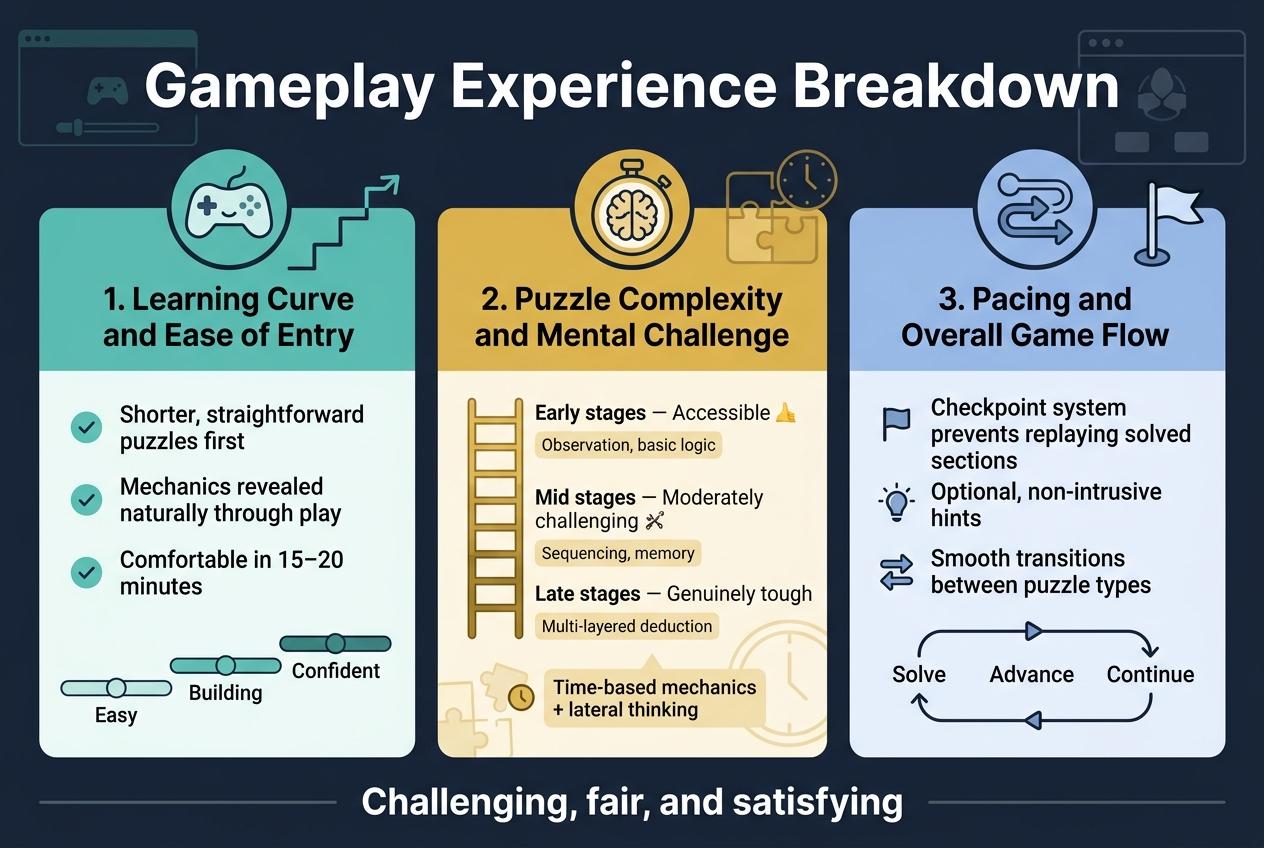
Getting into Jikan Nazo doesn’t feel like jumping off the deep end. The game eases you in with shorter, more straightforward puzzles before gradually pushing you toward trickier challenges. New players will appreciate that there’s no dense rulebook to memorize upfront — the mechanics reveal themselves naturally as you play.
That said, the onboarding isn’t hand-holdy to the point of being boring. You pick things up quickly, but the training wheels come off at a reasonable pace. For anyone exploring Jikan Nazo gameplay for the first time, expect to feel comfortable within the first 15–20 minutes.
Puzzle Complexity and Mental Challenge Level
This is where Jikan Nazo earns serious points. The puzzles aren’t just about speed — they demand genuine lateral thinking, pattern recognition, and occasionally, a willingness to backtrack and rethink your assumptions.
Here’s a rough breakdown of how complexity scales:
| Stage Range | Difficulty Feel | Skills Tested |
|---|---|---|
| Early stages | Accessible | Observation, basic logic |
| Mid stages | Moderately challenging | Sequencing, memory |
| Late stages | Genuinely tough | Multi-layered deduction |
Among the best time puzzle games out there, Jikan Nazo holds its own by layering time-based mechanics onto puzzles that would already be solid on their own. It’s not artificially hard — the difficulty feels earned, not frustrating.
If you’ve played escape room-style puzzles before, you’ll hit a comfortable groove quickly. Newcomers to the genre might need a few retries on mid-game puzzles, but never to the point where quitting feels tempting.
Pacing and Overall Game Flow
The pacing is one of Jikan Nazo’s quiet strengths. Sessions rarely drag or feel rushed. Each puzzle segment has a natural endpoint that signals a good stopping point, which makes it easy to play in short bursts without losing your thread.
A few things that keep the flow smooth:
- Checkpoint system prevents repetitive replaying of solved sections
- Hint mechanics are optional and non-intrusive — they don’t break immersion
- Transition between puzzle types keeps things feeling fresh without being chaotic
The rhythm of the game feels deliberate. You’re challenged, you solve, you move forward — and that loop stays satisfying well into the later stages.
Strengths That Make Jikan Nazo Stand Out
Most Rewarding Moments and Satisfying Achievements
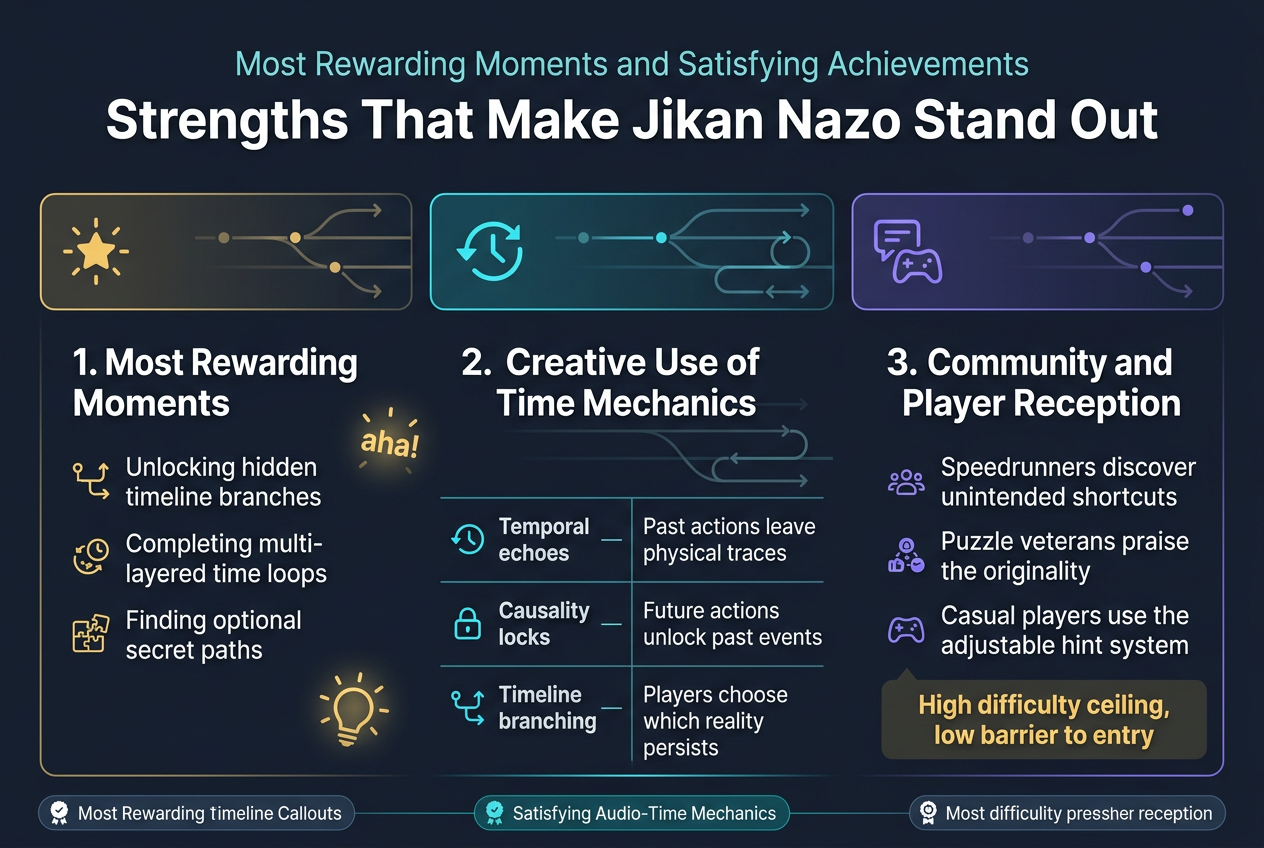
The biggest highs in Jikan Nazo come when everything clicks — you’ve been staring at a puzzle for minutes, manipulating timelines back and forth, and then suddenly the solution reveals itself like a magic trick you finally figured out. That “aha” feeling hits harder here than in most puzzle games because the solutions are genuinely clever, not just clever-looking.
Standout rewarding moments include:
- Unlocking hidden timeline branches that completely recontextualize earlier puzzles
- Completing multi-layered time loops where every action in one era perfectly syncs with another
- Finding optional secret paths that reward curious, experimental players generously
These moments alone make Jikan Nazo worth buying for dedicated puzzle fans who love feeling genuinely smart after solving something difficult.
Creative Use of Time Mechanics in Problem Solving
This is where Jikan Nazo really separates itself from other best time puzzle games on the market. Instead of using time simply as a rewind button, the game treats it as an active ingredient in every solution.
Some standout mechanical ideas:
| Mechanic | How It’s Used |
|---|---|
| Temporal echoes | Past actions leave physical traces that affect present-state puzzles |
| Causality locks | Some events can only happen if a future version has already done them |
| Timeline branching | Players choose which version of reality persists |
These mechanics stack in ways that feel surprising but never cheap. The design respects your intelligence — it teaches rules quietly and then breaks them in satisfying ways. From a pure game-design standpoint, Jikan Nazo gameplay holds up remarkably well against genre heavyweights.
Community and Player Reception Highlights
Player reception has been genuinely warm, especially among hardcore puzzle communities. A few consistent threads show up in player discussions:
- Speedrunners have embraced it, discovering unintended shortcuts that the developers openly celebrate
- Puzzle veterans frequently call it one of the more original takes on temporal mechanics they’ve encountered recently
- Casual players appreciate the adjustable hint system, making it accessible without dumbing anything down
An honest Jikan Nazo review from the community side shows a rare combination: high difficulty ceiling with low barrier to entry. Player-created guides and walkthroughs started appearing within days of launch, which signals strong engagement and genuine passion for the game’s design.
Drawbacks and Limitations to Consider
Common Frustrations Reported by Players
Players who’ve spent significant time with Jikan Nazo tend to flag a few recurring pain points:
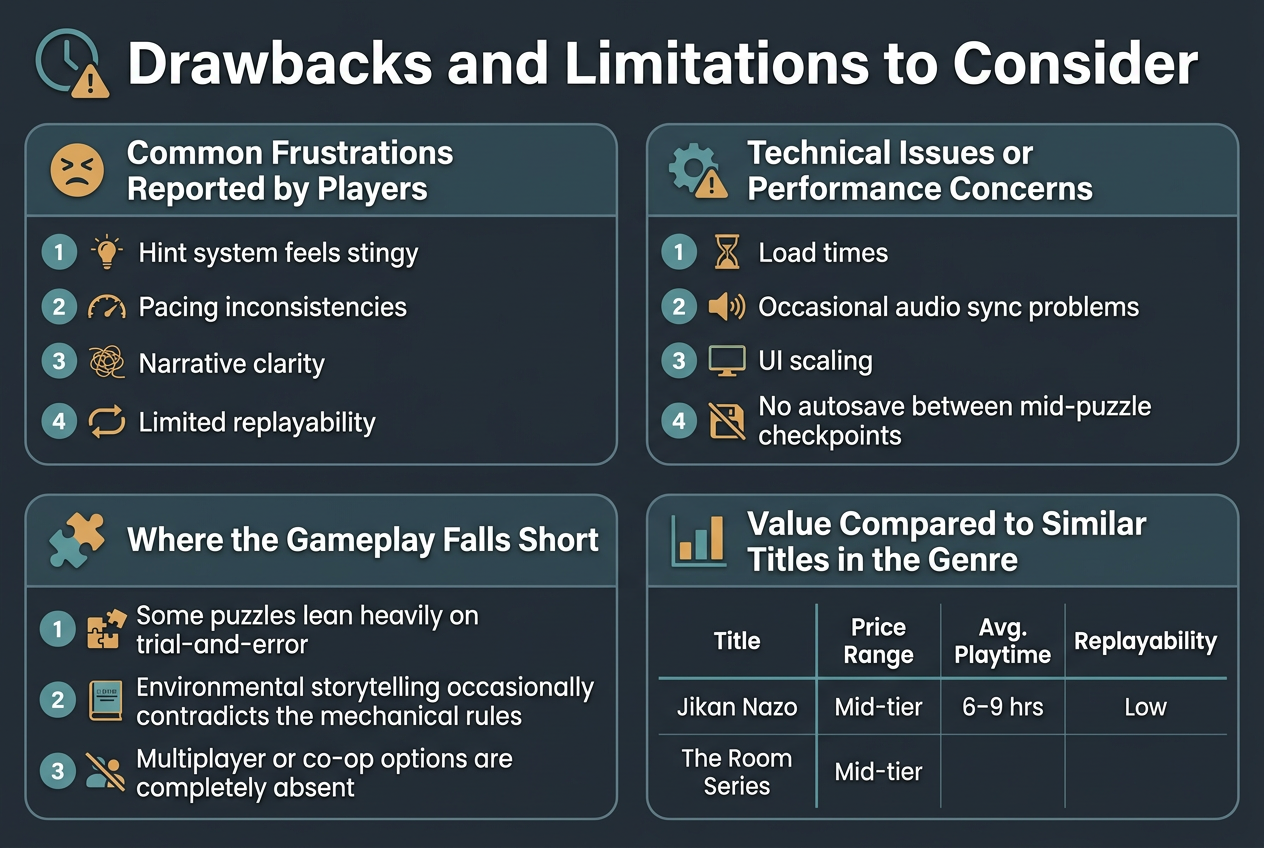
- Hint system feels stingy — when you’re genuinely stuck, the available hints rarely push you far enough to make real progress
- Pacing inconsistencies — early puzzles feel almost too breezy, then difficulty spikes sharply without much warning
- Narrative clarity — the time-bending story is intriguing but leaves too many threads unresolved, which frustrates players who invest emotionally in the plot
- Limited replayability — once you’ve cracked the core puzzles, there’s little reason to return
Technical Issues or Performance Concerns
Jikan Nazo runs cleanly on most modern hardware, but a handful of issues do pop up:
- Load times between puzzle segments can feel sluggish, especially on older devices
- Occasional audio sync problems where ambient sound cues — which are often tied to puzzle mechanics — drift out of alignment
- UI scaling on ultrawide monitors isn’t fully optimized, leaving awkward empty space on screen edges
- No autosave between mid-puzzle checkpoints, meaning a crash at the wrong moment costs real progress
These aren’t game-breaking issues, but they’re noticeable enough to chip away at immersion during longer sessions.
Areas Where the Gameplay Falls Short of Expectations
For an honest Jikan Nazo review, this part matters. The time-manipulation mechanics are genuinely clever in concept, but execution has gaps:
- Some puzzles lean heavily on trial-and-error rather than rewarding logical deduction
- The environmental storytelling occasionally contradicts the mechanical rules the game itself establishes, which breaks immersion
- Multiplayer or co-op options are completely absent — something players of similar titles have come to expect
Value Compared to Similar Titles in the Genre
Here’s a quick look at how Jikan Nazo stacks up against comparable time puzzle games:
| Title | Price Range | Avg. Playtime | Replayability |
|---|---|---|---|
| Jikan Nazo | Mid-tier | 6–9 hrs | Low |
| The Room Series | Mid-tier | 4–6 hrs | Low-Medium |
| Outer Wilds | Premium | 15–25 hrs | High |
| Manifold Garden | Mid-tier | 3–5 hrs | Low |
If you’re weighing whether Jikan Nazo is worth buying purely on content volume and replay value, it doesn’t dominate this space. Players wanting a longer, richer experience for a similar price point have stronger alternatives available.
Pricing and Value Assessment
Cost Breakdown Across Available Editions
Jikan Nazo is available in three editions, giving players some flexibility depending on how deep they want to dive in:
| Edition | Price | What’s Included |
|---|---|---|
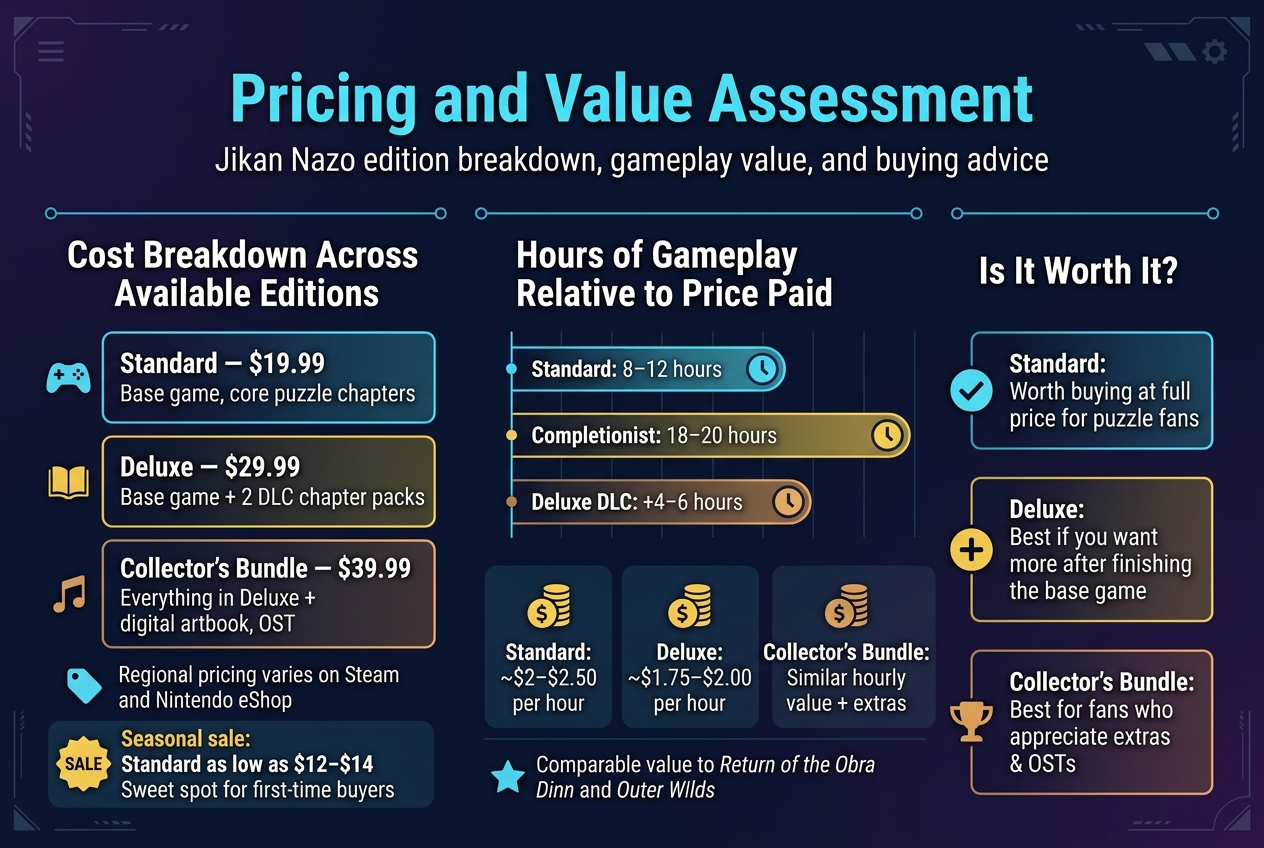
| Standard | $19.99 | Base game, core puzzle chapters |
| Deluxe | $29.99 | Base game + 2 DLC chapter packs |
| Collector’s Bundle | $39.99 | Everything in Deluxe + digital artbook, OST |
Regional pricing varies slightly on Steam and Nintendo eShop, so it’s worth checking your local storefront before purchasing. Sales during seasonal events can push the Standard edition as low as $12–$14, which is arguably the sweet spot for first-time buyers.
Hours of Gameplay Relative to Price Paid
The Standard edition delivers roughly 8–12 hours of gameplay for a typical playthrough, though completionists chasing all hidden timelines and alternate endings can stretch that to 18–20 hours. The Deluxe DLC chapters add another 4–6 hours on top.
Breaking that down:
- Standard: ~$2–2.50 per hour of gameplay
- Deluxe: ~$1.75–2.00 per hour with DLC included
- Collector’s Bundle: Similar hourly value with added non-gameplay extras
For a time puzzle game in this genre, that cost-per-hour sits comfortably in line with similar titles like Return of the Obra Dinn and Outer Wilds—both considered exceptional value by their communities.
Whether the Experience Justifies the Investment
If you’re someone who genuinely enjoys mentally engaging puzzle games where every playthrough reveals something new, Jikan Nazo is worth buying at Standard pricing without hesitation. The replayability factor is real—multiple endings and branching timelines mean you’ll likely return to it more than once.
The Deluxe upgrade makes sense if you finish the base game and find yourself wanting more. It’s not essential upfront, but the added chapters feel like a natural continuation rather than content cut from the main game.
The Collector’s Bundle is really for fans who already know they love the experience. The artbook and soundtrack are genuinely high quality, but they won’t add to your enjoyment of the puzzles themselves.
Casual players or those unsure about the genre might want to wait for a sale on the Standard edition before committing—but for puzzle game enthusiasts, full price is a fair ask.
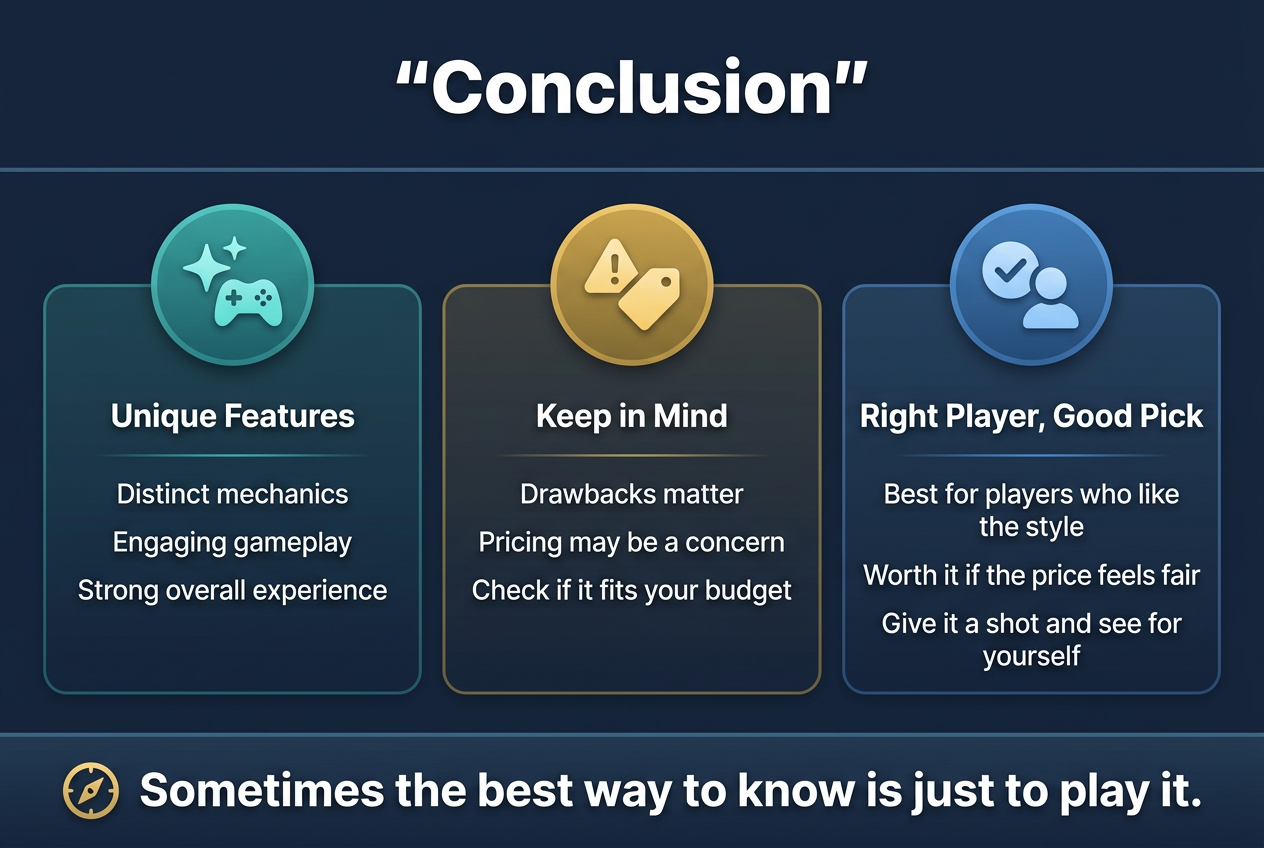
Jikan Nazo brings a solid mix of unique features and engaging gameplay that makes it stand out in its space. The strengths are real — from its distinct mechanics to the overall experience it delivers. That said, the drawbacks and pricing are worth keeping in mind before you jump in, especially if you’re on the fence about whether it fits what you’re looking for.
At the end of the day, Jikan Nazo is a decent pick for the right kind of player. If the gameplay style clicks with you and the price feels fair for what you get, it’s hard to go wrong. Give it a shot and see for yourself — sometimes the best way to know is just to play it.