
Short Story Engine Review
Introduction
Writing and publishing a book is only half the battle for most authors. The real challenge comes after: finding readers, building awareness, creating content consistently, and developing an audience willing to engage with your work.
Many indie authors find themselves in the same predicament—the book is finished, uploaded to Amazon, and then… crickets. Amazon’s algorithm isn’t going to magically introduce their work to the right readers. They need a discovery strategy.
This is where the concept of companion content enters the picture. Instead of expecting readers to make the leap straight from “never heard of you” to “let me buy your $12 book,” what if you offered them a free, smaller commitment first? A short story that introduces them to your writing, your characters, and your world?
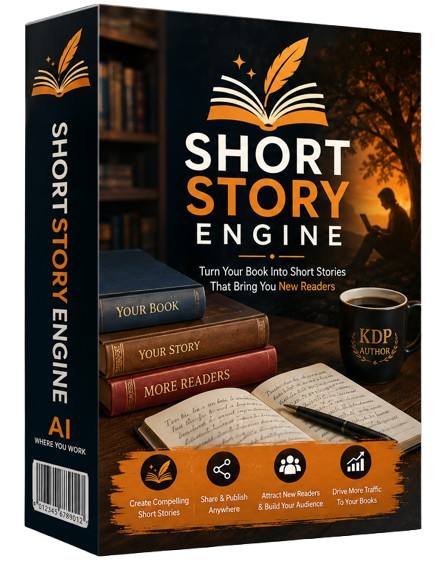
Short Story Engine is positioned as a solution for exactly this problem. It’s an AI-powered tool designed to help authors extract companion stories from existing books, manuscripts, or even just story ideas—then use those stories as reader magnets and discovery content.
But does it actually work? Is it worth the investment? And more importantly, is it the right tool for your writing business?
This Short Story Engine review breaks down the features, pricing, real-world applications, and limitations so you can make an informed decision.


Short Story Engine Review at a Glance
| Feature | Details |
|---|---|
| Product Name | Short Story Engine |
| Category | AI Storytelling / Author Marketing |
| Best For | KDP and self-publishing authors |
| Primary Function | AI-assisted short-story creation and reader-building strategy |
| Included With Purchase | Story creation engine + Short Story Traffic Playbook |
| Frameworks Provided | 7 companion-story templates |
| Pricing | $27 (with STORYVIP coupon code) |
| Payment Type | One-time purchase |
| Money-Back Guarantee | 30 days (according to product information) |
| Best Use Case | Creating reader-discovery opportunities through companion stories |
| Requires | External email platform for audience building |
What Is Short Story Engine?
According to the product information, Short Story Engine is an AI-powered short-story creation engine built around authors’ intellectual property. The core idea is straightforward: authors often have material—characters, scenes, settings, and backstories—that could become standalone stories but never do.
These unused story elements stay trapped inside the main book. Short Story Engine attempts to help authors:
- Identify smaller story opportunities within their existing work
- Create standalone short stories using AI assistance
- Package those stories as reader magnets or promotional content
- Repurpose each story into multiple marketing assets
The tool works with authors who have an existing published book, a completed manuscript, a detailed outline, or even just a concept. This flexibility is important because it means authors at different stages can potentially use the tool.
What Short Story Engine doesn’t do: it doesn’t publish your book, manage your email list, or guarantee that readers will buy your work. It’s a creation and strategy tool, not an end-to-end publishing platform.
You’re Also like this : Royalty Profits AI Review 2025: The Ultimate AI-Powered Amazon KDP Publishing Solution
Who Is Short Story Engine For?
KDP Authors
Amazon KDP authors are the primary audience. For authors publishing on Kindle, the challenge is discoverability. A short story distributed through a newsletter, social media, or reader magnet platform can serve as an introduction to their writing. Once readers enjoy the short story, a link back to the main book becomes a logical next step.
Self-Published Authors
Beyond KDP, indie authors publishing through other platforms can use companion stories as promotional tools. Whether you’re publishing through IngramSpark, Draft2Digital, or directly through your website, short-story content can funnel readers toward your main work.
Fiction Writers
Novelists and genre fiction writers—romance, fantasy, sci-fi, mystery—often have rich story worlds with multiple characters and timeline possibilities. Companion stories can explore side characters, past events, holiday specials, or bridge stories between series books.
Aspiring Authors
Writers who haven’t finished a book yet may find value in creating short-story content to build an audience before launching their full-length work. This approach lets them test their ideas, build reader familiarity, and potentially have an email list ready when the book launches.
Nonfiction and Educational Authors
While the tool is strongest for story-driven publishing, some nonfiction authors might use illustrative short stories or case-study narratives. However, the frameworks are primarily designed for fiction.
How Does Short Story Engine Work?
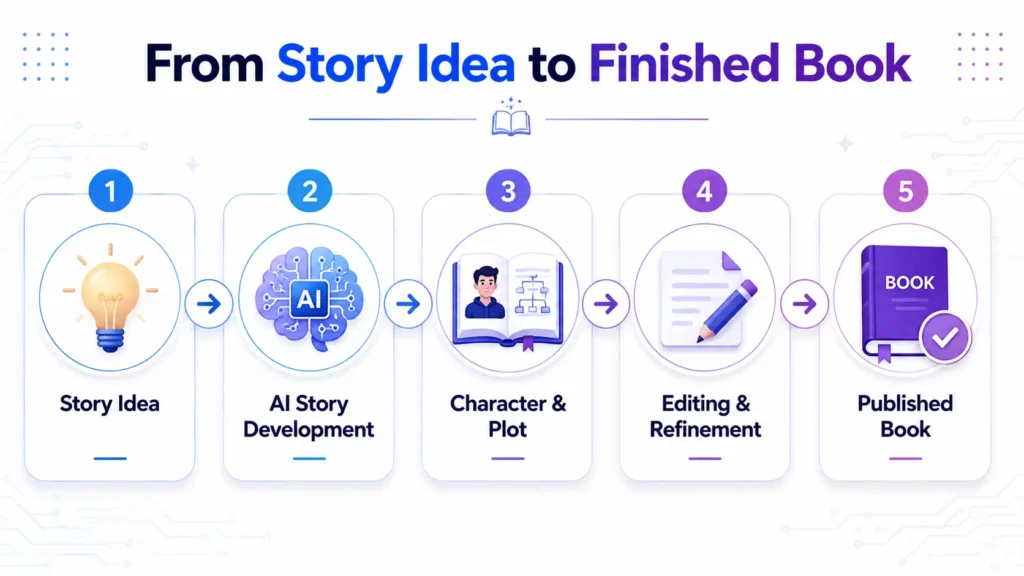
The workflow follows a logical progression:
Step 1: Start with source material — Add an existing book, manuscript, character sketch, story world description, or even just a concept.
Step 2: Identify story opportunities — Use the provided frameworks to spot what smaller stories could exist within or around your main narrative.
Step 3: Generate a short story — The AI engine assists in creating a complete standalone story based on your source material.
Step 4: Edit and improve — This is critical: AI-generated content requires human review, editing, and fact-checking before it’s ready. The tool creates the draft; you refine it.
Step 5: Repurpose into multiple assets — One short story can become newsletter content, social media posts, serialized installments, excerpts, quotes, and more.
Step 6: Use for reader discovery — Publish the story as a free reader magnet, share it on platforms where your audience hangs out, or serialize it to build email subscribers.
The key difference between “creating a story” and “creating a story for reader discovery” is intent. A random short story is just content. But a short story strategically connected to your main book and positioned to introduce new readers to your work becomes a lead-generation asset.
You’re Also like this : Ghost Mystery Royalties Bot Review — Is It Legit or a Scam?
Short Story Engine Features
AI Short Story Creation Engine
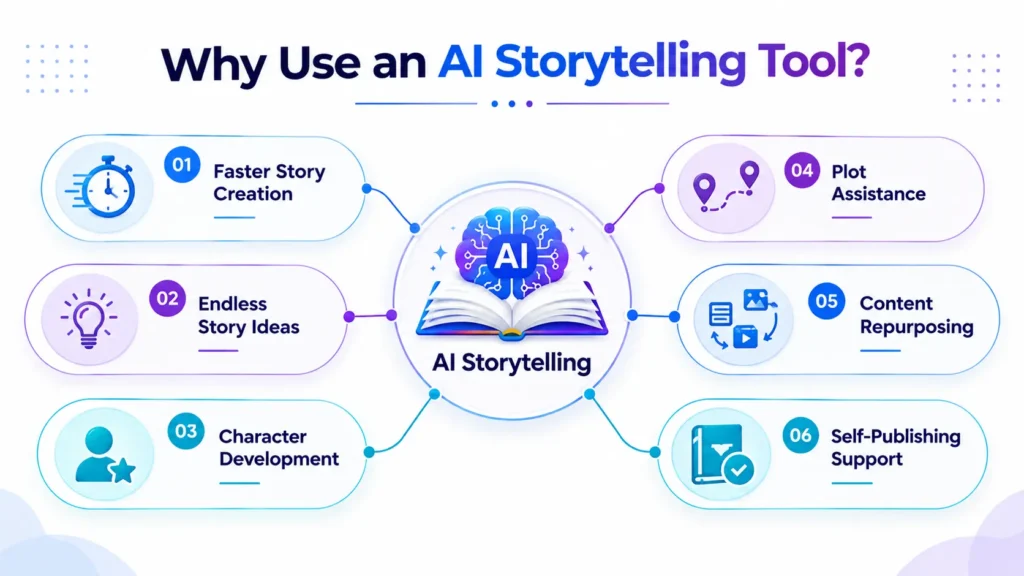
The core feature is an AI tool that helps generate complete short stories. Rather than starting from a blank page, authors can input information about their book, characters, or ideas, and the engine produces a draft. The output is meant to serve as a foundation that the author then edits and personalizes.
Seven Companion-Story Frameworks
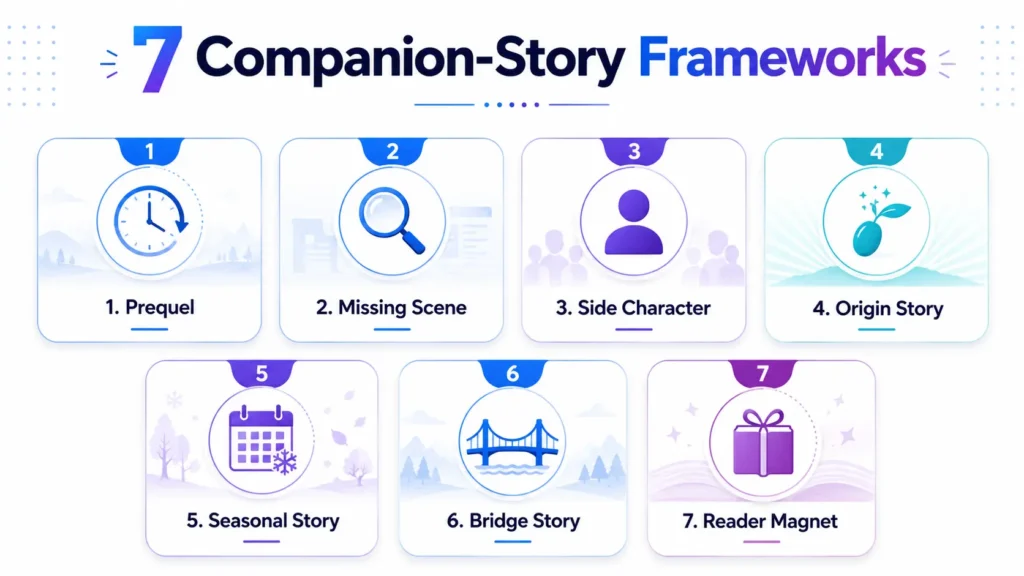
Instead of leaving short-story creation open-ended, the product provides seven specific templates:
- Prequel Stories — What happened before the main narrative?
- Missing Scenes — Off-page events or unseen conversations from the main book
- Side-Character Spotlights — Stories focused on secondary characters
- Character Origin Stories — How did a key character become who they are?
- Seasonal Stories — Holiday, anniversary, or event-based narratives
- Bridge Stories — Content connecting different books in a series
- Reader-Magnet Exclusives — Stories designed specifically to incentivize email signups
Each framework narrows the creative space, making it easier to identify and generate relevant companion content.
Short Story Traffic Playbook
This is the strategy component. According to the product information, the Playbook includes:
- Guidance on why short stories work for reader discovery
- Best practices for different companion-story types
- How to repurpose one story into multiple content assets
- Social sharing and newsletter strategies
- Reader magnet tactics
- A 30-day short-story traffic plan (broken into four weekly phases)
- Templates and checklists for consistency
The Playbook is intended to answer the question many authors ask: “Okay, I created a short story. Now what do I actually do with it?”
30-Day Short Story Traffic Plan
The product includes a structured four-week framework:
- Week 1 — Create & Introduce: Generate and publish your first short story
- Week 2 — Share & Serialize: Distribute across platforms and start serializing
- Week 3 — Capture Interest: Gather email subscribers using the story as a magnet
- Week 4 — Repurpose & Reconnect: Turn the story into multiple asset types and guide readers back to your main book
This structure gives authors a repeatable process rather than leaving them to figure out the strategy on their own.
Reader Magnet Strategy
A reader magnet is a free incentive designed to build an email list. The product positions short stories as more concrete reader magnets than generic guides or checklists. A complete short story requires more effort to create but potentially offers more value to the reader.
Social Media and Content Repurposing
The Playbook explains how to break a single short story into dozens of pieces: opening hooks, character quotes, scene excerpts, serialized installments, and discussion prompts for social media.
The 7 Companion-Story Frameworks Explained
Understanding these frameworks helps you see the range of creative possibilities:
1. Prequel Moment
What it is: A story set before the main narrative begins, exploring events that shaped the current story.
Example: If your book follows a detective solving a crime in 2024, a prequel might show how that detective became obsessed with justice after a personal tragedy in 1998.
Reader discovery value: Prequels allow you to introduce your story world and characters without requiring readers to have prior knowledge.
2. Missing Scene
What it is: A scene that exists “off-page” in your original book—something mentioned but not shown.
Example: In your romance novel, a crucial conversation happened between chapters. The missing scene shows that exact dialogue.
Reader discovery value: Missing scenes feel like insider content—exclusive material existing readers want, and newcomers find intriguing.
3. Side-Character Spotlight
What it is: A story centered on a secondary character from your main book.
Example: Your fantasy novel features a merchant who appears in three scenes. A spotlight story shows her day, her struggles, and her connection to the main plot.
Reader discovery value: Readers who connect with a side character might pursue the main book to see that character’s full arc.
4. Character Origin Story
What it is: A deep exploration of how a character became who they are.
Example: Why did your protagonist become a writer? What shaped their values? What defining moment changed their life?
Reader discovery value: Origin stories let readers fall in love with a character before they encounter the main story.
5. Seasonal Story
What it is: A standalone story tied to a specific season, holiday, or anniversary.
Example: A Christmas-themed story featuring your characters, or a back-to-school story for a YA series.
Reader discovery value: Seasonal stories can be published at relevant times throughout the year, creating multiple entry points for new readers.
6. Bridge Story
What it is: Content connecting different books in a series or major sections of a longer narrative.
Example: Between Book 1 and Book 2 of your trilogy, a bridge story resolves a cliffhanger or introduces a new conflict.
Reader discovery value: Readers finishing one book can immediately engage with bridge content, maintaining momentum toward the next book.
7. Reader-Magnet Exclusive
What it is: A story created specifically to incentivize email signups—exclusive, available nowhere else.
Example: “Sign up for my newsletter and get this exclusive short story about how [main character] spent their 21st birthday.”
Reader discovery value: Exclusive content has built-in scarcity and perceived value, encouraging email subscriptions.
How Short Stories Can Help With Book Marketing
The traditional funnel often looks like:
Stranger → Amazon Product Page → Buy Book
That’s a big ask. Someone who’s never heard of you now has to trust you enough to spend $9.99 on your book. Many won’t take that leap.
A short-story-focused approach creates intermediate steps:
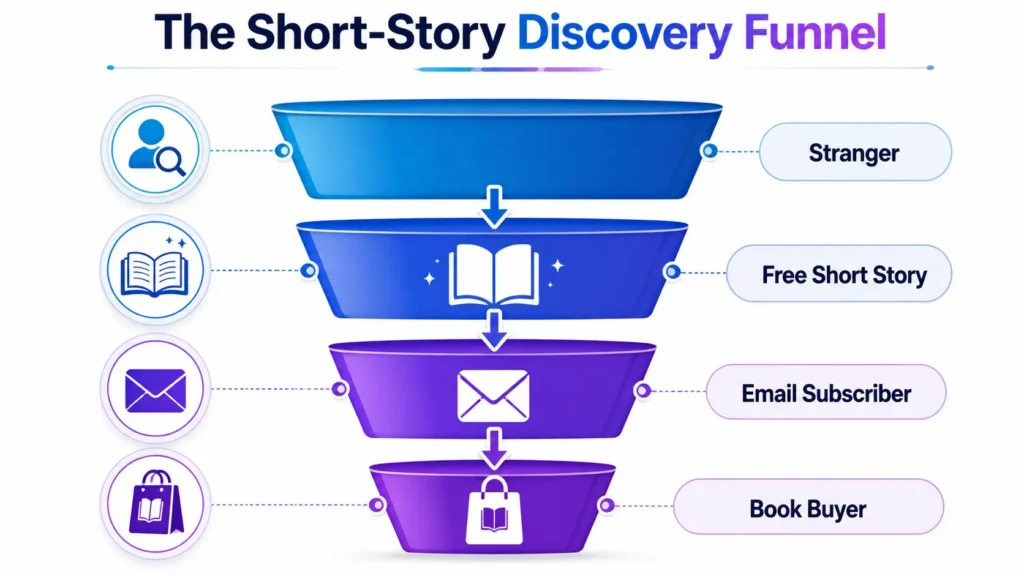
Stranger → Free Short Story → Enjoys Your Writing → Joins Email List → Discovers Your Main Book → Purchases
Each step is a smaller commitment. A free short story requires no financial risk. Joining an email list is easier than buying a book. By the time someone receives an email about your main book, they’ve already experienced your writing voice and story world.
This doesn’t guarantee book sales—there’s no guaranteed conversion rate here—but it does reduce friction at each stage.
Using Short Story Engine to Build a Reader Magnet
A reader magnet is a free gift used to incentivize email signups. Common examples include:
- Free chapters
- Writing guides
- Story templates
- Short stories
- Character guides
Why short stories specifically? According to the product information, a complete short story is more concrete and valuable than an abstract resource. Readers prefer actual content over guides. A well-crafted short story gives them an immediate, enjoyable reason to join your audience.
Important: Short Story Engine itself is not an email service. You’ll still need an email platform (ConvertKit, MailerLite, Substack, etc.) to actually collect emails and send messages. Short Story Engine helps you create the magnet; it doesn’t manage your subscriber relationships.
You’re Also like this : Shigai Royalty Review : Can This Mystery Puzzle Tool Really Help You Create KDP Books?
Turning One Short Story Into Multiple Marketing Assets
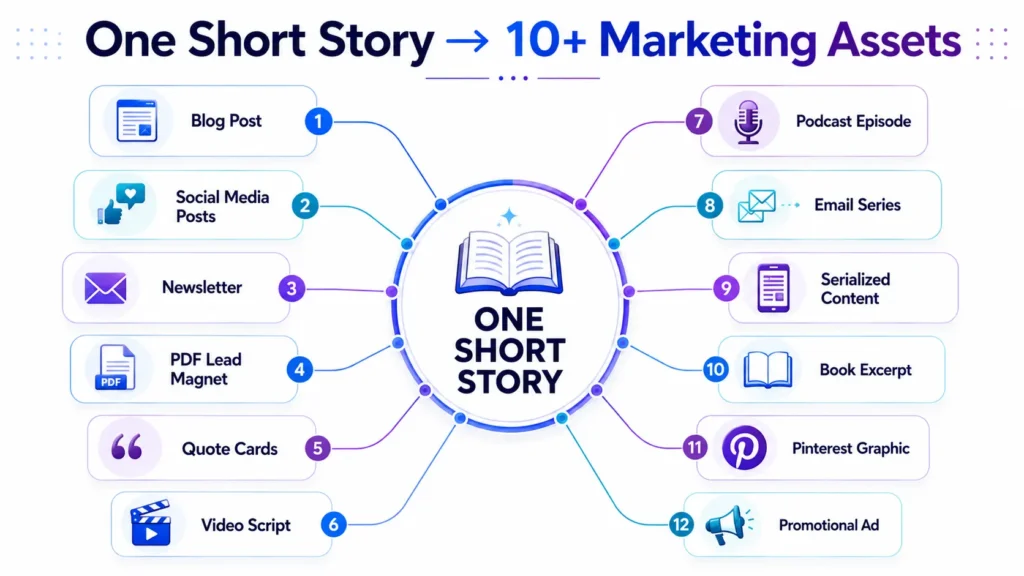
One of the most powerful aspects of short-story marketing is content repurposing. A single completed short story can become:
- The full short story (PDF, email series, blog post)
- Serialized installments (one part per day or week)
- Social media posts (hooks, quotes, character moments)
- Newsletter content (exclusive sections or behind-the-scenes)
- Excerpts (the most compelling 500-1000 words)
- Pull quotes (memorable dialogue or description)
- Character spotlight posts
- World-building details
- Discussion prompts
- Promotional material for your main book
This content repurposing approach extends your return on investment. If you spend time creating one short story, you can extract weeks or months of promotional content from it.
Short Story Engine Pros and Cons
Pros
Author-focused workflow — The tool is designed specifically for authors, not general writers. The frameworks and strategy are tailored to publishing and reader-building.
Seven proven frameworks — Rather than staring at a blank page, authors have seven specific templates guiding story creation.
Included strategy component — The Traffic Playbook isn’t sold separately; it comes with the base purchase. You get both creation and strategy.
Content repurposing guidance — The product explains how to turn one story into multiple assets, maximizing the value of your effort.
Works at multiple stages — Whether you have a finished book, a manuscript, or just an idea, the tool accommodates different starting points.
One-time payment — According to the supplied offer, there’s no monthly subscription or ongoing fees.
Affordable entry point — At $27, the barrier to trying the tool is relatively low.
Cons
AI output requires significant editing — This can’t be overstated. AI-generated stories are drafts, not finished products. You’ll spend time editing, fact-checking, and refining every story.
Doesn’t replace good storytelling — If your underlying story isn’t strong, the AI can’t fix that. The tool amplifies your creative decisions; it doesn’t replace them.
No guaranteed results — Creating short stories doesn’t guarantee readers will find them, enjoy them, or buy your main book. Marketing and distribution still matter enormously.
Requires external email platform — You’ll need to invest in or already have an email service to actually capture subscribers from your reader magnets.
May not suit all authors — Nonfiction authors, poets, or writers of very short flash fiction might not find these frameworks relevant.
General AI tools can do similar work — Authors with ChatGPT or Claude experience might generate companion stories without this tool. Short Story Engine’s value is in the structure and strategy, not in unique AI capability.
Success depends on author effort — The tool creates the framework. You still have to create, edit, publish, and promote. It’s not a “set it and forget it” solution.
Short Story Engine Pricing
According to the product information supplied:
- Regular stated value: $197+
- Launch price: $27
- Coupon code: STORYVIP (stated as providing a $10 discount)
- Payment structure: One-time purchase
- Recurring costs: None mentioned
- Money-back guarantee: 30 days (according to the offer)
The $27 price point is positioned as a limited-time launch offer, not a permanent price. Typical pricing information suggests it may increase after the launch period.
The $197+ stated value refers to the combined value of the engine, Traffic Playbook, and other included resources according to the sales page. This is a marketing claim and shouldn’t be interpreted as independently verified market pricing.
Short Story Engine Coupon Code
According to the product information, this coupon provides a $10 discount, bringing the price to $27.
Important: Coupon availability and discounts can change. Always confirm the current pricing and coupon validity at checkout before assuming any discount applies.
Is Short Story Engine Worth $27?
Whether Short Story Engine is worth the investment depends on your specific situation.
It’s likely worth it if you:
- Have an existing book or detailed manuscript
- Want to build an email audience before or after launch
- Are willing to edit and refine AI-generated content
- Understand that companion stories support marketing but don’t guarantee sales
- Prefer a structured, author-focused workflow over general AI writing tools
- Plan to repurpose stories into multiple content pieces
It may not be worth it if you:
- Expect finished, publish-ready stories without editing
- Don’t have time or interest in marketing through content
- Don’t need short-story content (some authors don’t)
- Are looking for guaranteed book sales or traffic
- Already use general AI tools comfortably and don’t need additional structure
- Have minimal interest in audience building
At $27, the financial risk is relatively small. For most authors, a month’s worth of coffee costs more. The real investment is your time—both in using the tool and in following through with creating, editing, and promoting the stories.
You’re Also like this : Sansuu Royalty Review: 3 Amazing Reasons Beginners Create Math Workbooks in Minutes
Who Should Buy Short Story Engine?
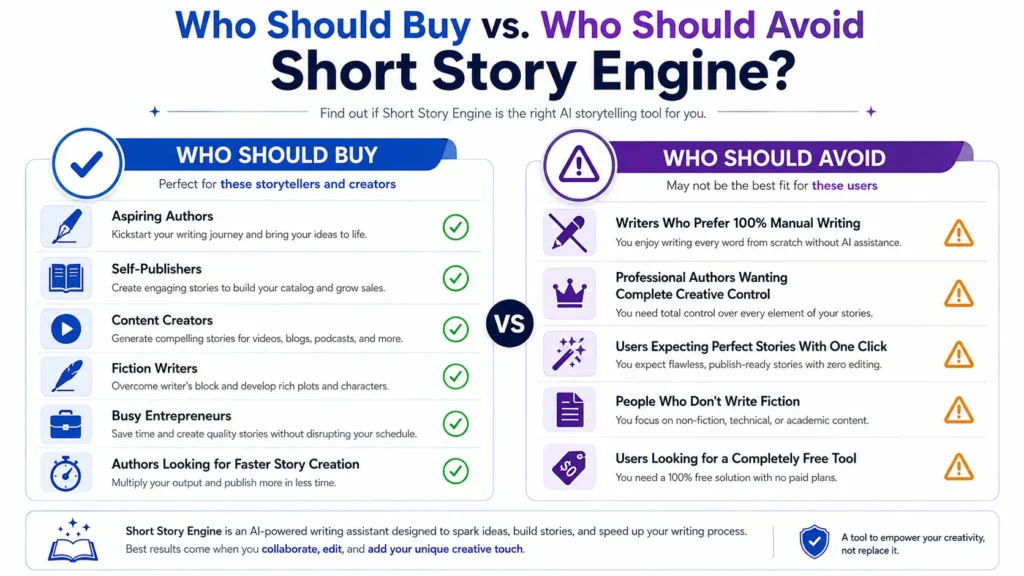
Consider purchasing if you’re a:
- KDP author wanting to build awareness and email subscribers
- Series author looking to create bridge content between books
- Pre-launch author seeking to build audience before release
- Fiction writer with rich story worlds and character backstories
- Author struggling with marketing strategy and wanting structured guidance
- Content creator interested in maximizing content ROI through repurposing
The strongest fit is authors who already recognize the value of companion content but don’t know where to start.
Who Should Avoid Short Story Engine?
Reconsider if you:
- Don’t intend to market or build an audience
- Expect fully finished stories without significant personal editing
- Write genres where short stories aren’t marketable (some nonfiction categories, academic writing)
- Are looking for an automated system to build a passive income business
- Don’t have an email platform or audience-building infrastructure and aren’t willing to set it up
- Are suspicious of AI-generated content and prefer fully human-written work
Short Story Engine Alternatives
Authors have several alternatives for creating companion content:
General AI Writing Assistants — ChatGPT, Claude, and similar tools can generate short stories with good prompting. They don’t include strategy or frameworks, but they’re flexible and often cheaper.
Writing Software — Scrivener, Atticus, or Vellum help organize and format writing but don’t provide AI generation or marketing strategy.
Human Ghostwriters — Hiring a writer to create companion stories guarantees quality but costs significantly more ($500–$5,000+ per story).
DIY Approach — Write companion stories yourself using your existing writing skills, then use general marketing guidance for distribution.
Other Author-Focused Tools — Competing products exist in the author toolkit space, though exact features vary.
The best choice depends on your budget, technical comfort, writing ability, and time availability.
Frequently Asked Questions
What is Short Story Engine?
Short Story Engine is an AI-powered tool designed to help authors create companion short stories from existing books, manuscripts, or ideas. It includes story-creation assistance, seven narrative frameworks, and a marketing strategy guide.
Is Short Story Engine worth $27?
That depends on whether you plan to use short stories for reader discovery and marketing. For authors interested in companion content, the structured approach and included strategy provide value at this price point. Authors who don’t need short stories or prefer general AI tools may find less value.
What is the Short Story Engine coupon code?
The STORYVIP coupon code is stated to provide a $10 discount, bringing the price to $27. Verify current availability at checkout.
What’s included in the base purchase?
The product states it includes the AI creation engine, seven companion-story frameworks, and the Short Story Traffic Playbook covering 30-day strategy and repurposing guidance.
Is Short Story Engine good for KDP authors?
Yes—KDP authors are the primary target audience. The tool directly addresses discoverability challenges by creating reader magnets and discovery content.
Can I use Short Story Engine before my book is finished?
According to the product information, yes. Authors can start with an outline, concept, or partial manuscript. Short stories can be created independently to build audience before the main book launches.
Can Short Story Engine create reader magnets?
Yes. The tool includes frameworks and strategy specifically for creating short stories designed to incentivize email signups.
Does Short Story Engine guarantee book sales?
No. The product is a creation and strategy tool. It can’t guarantee that readers will find your work, enjoy it, or purchase your book.
Can I use ChatGPT instead?
Yes, general AI writing tools can generate short stories with good prompting. Short Story Engine’s advantage is its structured frameworks and included marketing strategy. If you’re comfortable with ChatGPT and don’t need guidance, it’s a viable alternative.
Do I still need to edit AI-generated stories?
Absolutely. AI output is a draft. You’ll need to review for accuracy, consistency, tone, and quality before publishing or sharing.
Do I need an email marketing platform?
Yes, if you plan to use short stories as reader magnets. Short Story Engine doesn’t include email collection or management; you’ll need a separate platform like ConvertKit, MailerLite, or similar.
Does Short Story Engine publish my book?
No. The tool creates stories and provides strategy. You handle publishing through your chosen platform (Amazon, IngramSpark, your website, etc.).
Final Verdict: Is Short Story Engine Worth It?
Short Story Engine is best viewed as a structured short-story creation and audience-building tool, not as a guaranteed path to book sales.
For KDP authors, indie publishers, and fiction writers ready to invest time in content marketing, it offers clear value:
- A logical creative framework eliminating blank-page paralysis
- Companion-story templates grounded in marketing logic
- Strategy guidance for converting stories into reader acquisition
- A low financial barrier to entry
The honest assessment: This tool works for authors who already believe in the value of companion content but need structure and strategy. It won’t convert skeptical authors who don’t plan to market or aren’t willing to edit AI content.
At $27 (with the STORYVIP coupon), the financial risk is low. The time investment—creating, editing, promoting—is real but manageable, especially if you plan to repurpose each story across multiple channels.
If you’re a self-published author frustrated by Amazon discoverability and interested in building an audience through content, this tool is worth testing. If you already use general AI writing tools comfortably or don’t plan to market, you may not see the additional value.
2 thoughts on “Short Story Engine Review: The Ultimate AI Storytelling Tool Worth $27?”