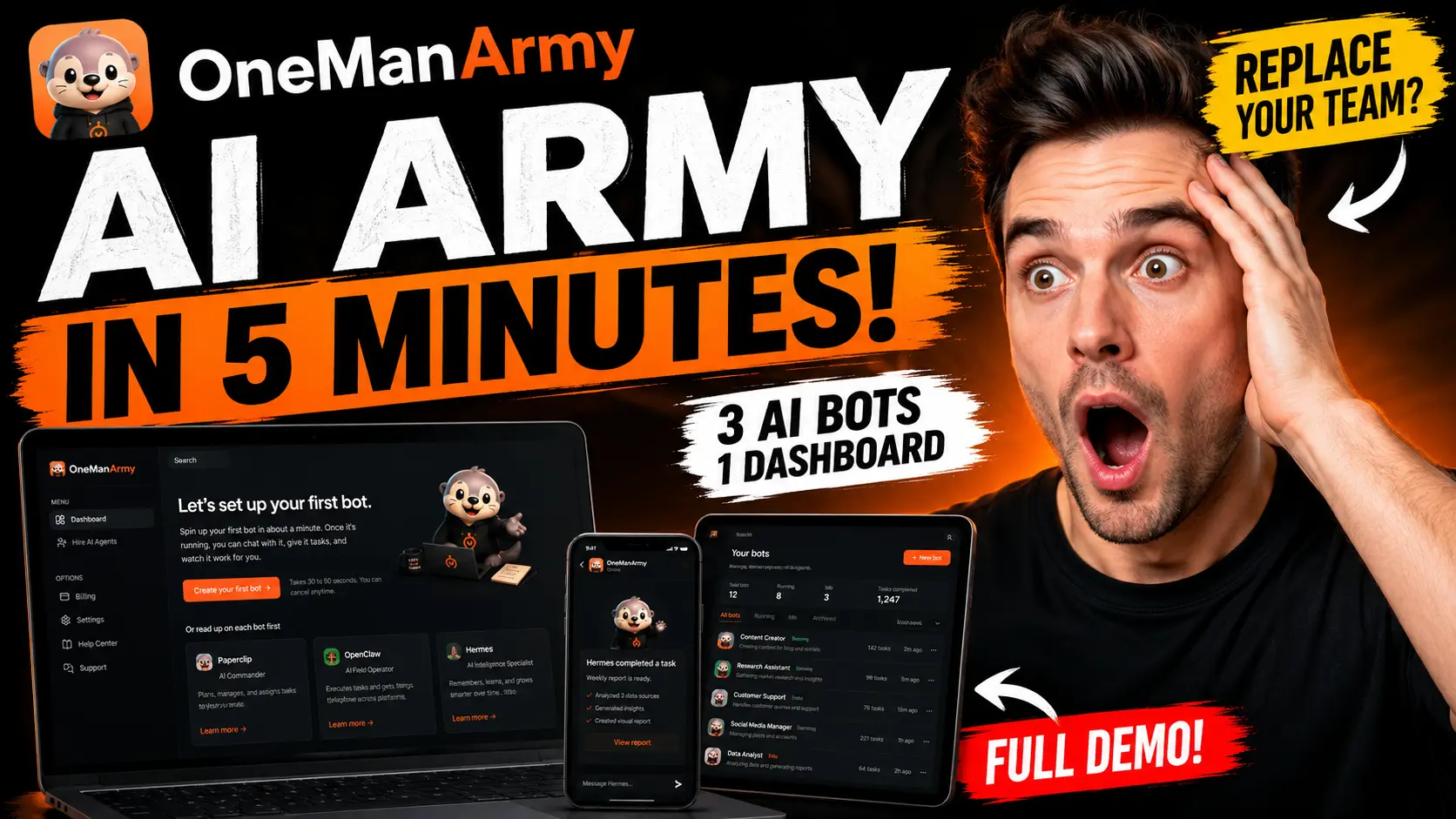
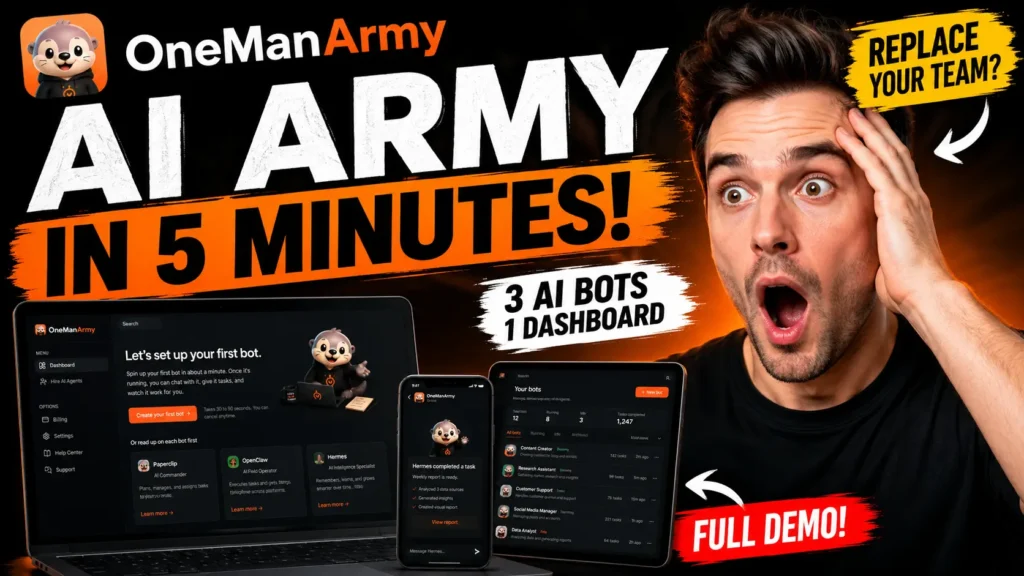
OneManArmy Review – My 4-Day Experience (Scam or Worth It?)
Introdution
Most JVZoo AI launches promise push-button automation, but OneManArmy positions itself differently — as an entire AI workforce controlled from one dashboard.
That’s a bold claim, and my first instinct was skepticism. I’ve reviewed enough JVZoo products to know that the gap between sales page and reality is usually significant. But something about the OneManArmy pitch felt worth a proper look. Instead of wrapping a single chatbot in a shiny UI, it’s built around three genuinely popular open-source AI projects: Paperclip, OpenClaw, and Hermes. The GitHub stars are real. The OpenRouter rankings they reference are public. So I decided to spend four days actually using it.
This OneManArmy review covers the full experience — setup, day-to-day testing, feature breakdown, pricing, upsells, and an honest answer to whether it’s worth your $47. I’ll also flag where the marketing oversells the product, because it does, and that matters.
If you’re an affiliate marketer, freelancer, or agency owner trying to figure out whether the OneManArmy AI platform is a legitimate tool or just another overhyped JVZoo launch, you’re in the right place.

Quick Verdict
| Description | Features |
|---|---|
| Product Name | OneManArmy |
| Creator | Rohit Shah & Todd Gross (BUILDRESULTTECH SERVICES LLP) |
| Front-End Price | $47 (one-time, launch pricing) |
| Launch Date | 2026 |
| Best For | Affiliate marketers, freelancers, agencies, AI enthusiasts |
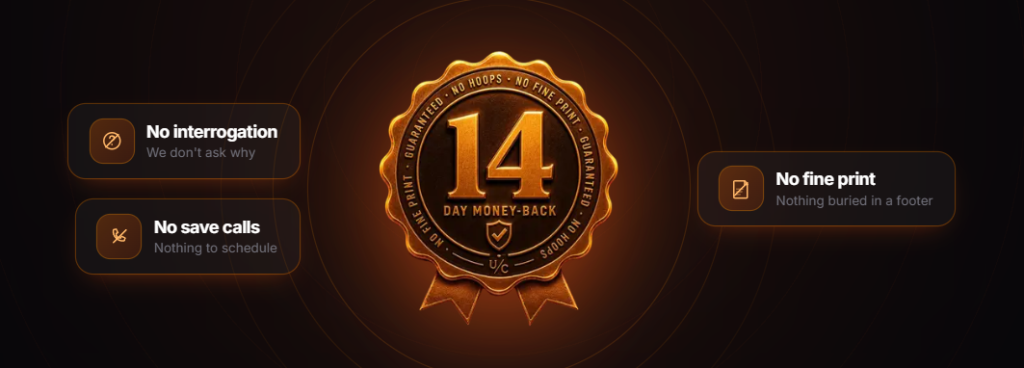
| Money-Back Guarantee | 14 days, no questions asked |
| Skill Level Required | Beginner to Intermediate |
| My Rating | 7.5 / 10 |
| Recommended? | Yes — with realistic expectations |
What Is OneManArmy?
OneManArmy is a hosted, browser-based platform that deploys three AI agent systems — Paperclip, OpenClaw, and Hermes — from a single command dashboard. The idea is that instead of individually installing and maintaining these open-source AI tools yourself (which requires Docker, server configuration, API key management, and regular maintenance), you get a managed, cloud-hosted version that can be up and running in under five minutes.
It’s browser-only, meaning nothing installs on your machine. You log in, deploy a bot, and start giving it instructions. The platform also integrates with Telegram, Slack, and Discord, so you can manage your AI agents directly from the messaging apps you already use.
Here’s what each of the three bots actually does:
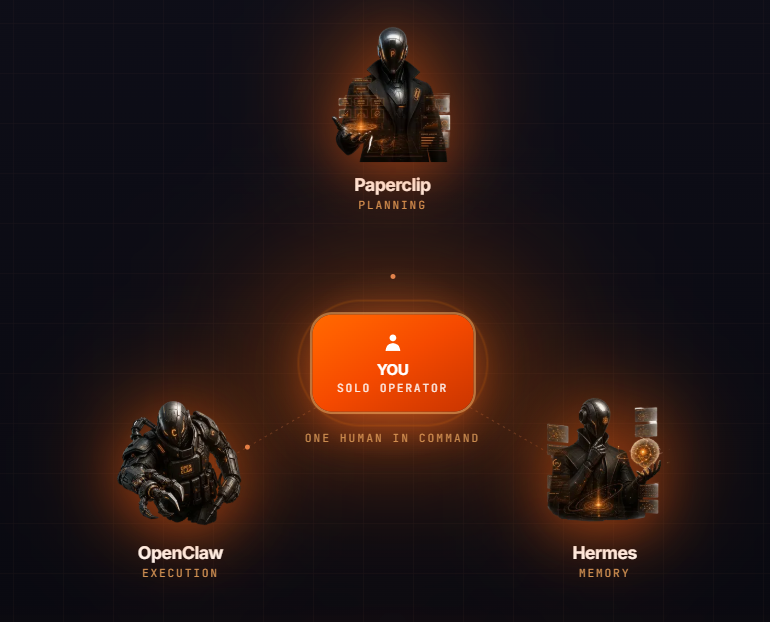
Paperclip is described as an AI Commander or “CEO.” You give it a goal, and it breaks that goal down into roles, job descriptions, and team structure. It requests to hire AI employees, which you then approve. Think of it as a project management layer that sits above everything else.
OpenClaw is the execution layer. It’s the action-taker — running skills, executing workflows, and handling real-world tasks like research, content drafting, and web tasks. It’s also the most technically demanding of the three to run independently, which is part of why the hosted version has genuine appeal.
Hermes is the memory and intelligence layer. It’s a self-learning system that writes its own skills as it works and retains memory of your business across sessions. As of mid-2026, it’s currently ranked number one on OpenRouter’s global token rankings — a real, publicly verifiable signal of how widely it’s being used.
All three are legitimate open-source projects with substantial GitHub followings. OneManArmy didn’t build these bots — they built the platform that lets you run all three from one place without needing an engineering background.
You may also like : InstantlyClaw Review: 1-Click AI Agent System That Builds a Full Business in 60 Seconds?
My 4-Day Experience Using OneManArmy
Day 1 — Setup and First Impressions
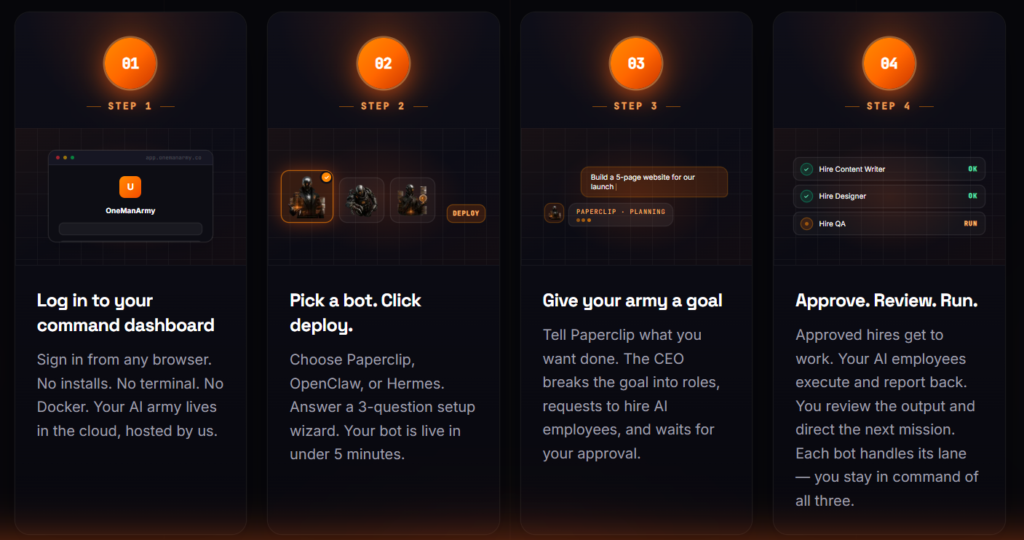
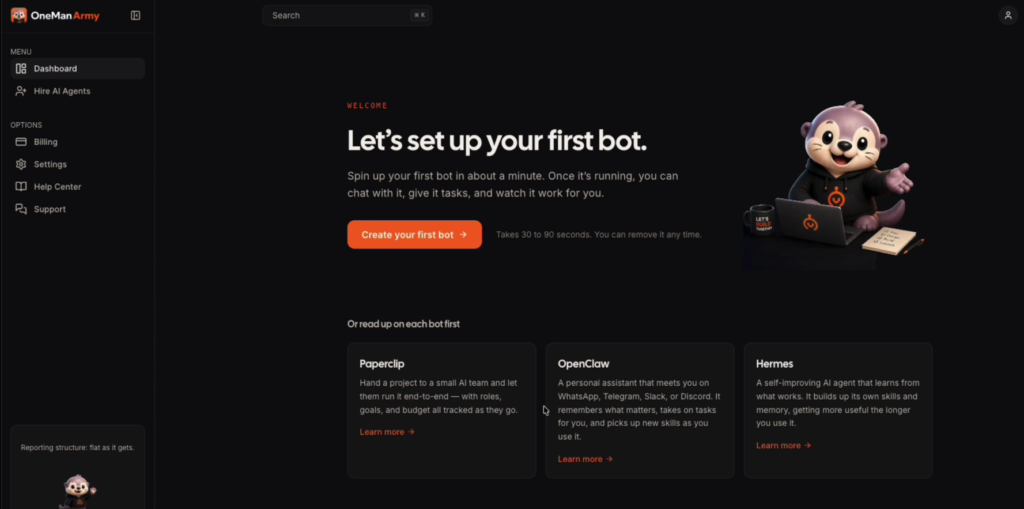
Getting started was genuinely smooth. After purchasing, I had access to the dashboard within minutes. The setup wizard asks three questions, picks your first bot, and you’re deployed. I had Hermes running in under five minutes, which matched what the sales page claims.
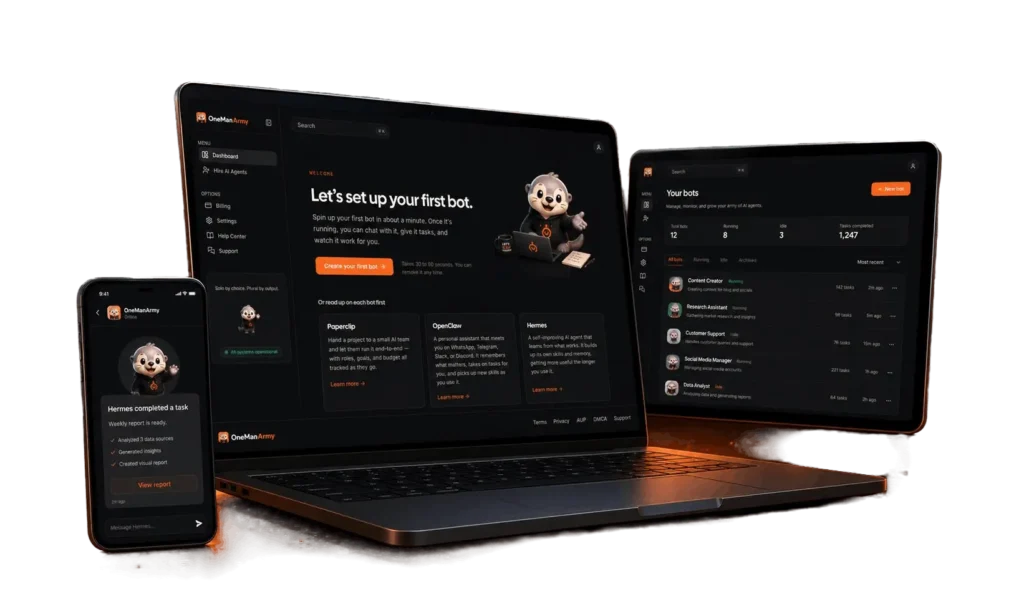
The dashboard itself is clean and fairly intuitive. Status indicators for each bot, one-click deploy and restart options, and a layout that doesn’t overwhelm you. Mobile-friendly too, which I appreciated.
That said, I want to be honest: there was still a learning curve. Understanding what each bot actually does, how to prompt it effectively, and how the three systems interact takes time. The Operator’s Academy training modules help, but they’re not a substitute for getting your hands dirty and experimenting. The sales page suggests you’ll be fully operational in minutes — that’s true for the technical setup, but the strategic side takes longer.
One thing I noticed immediately: the dashboard doesn’t automatically coordinate the bots with each other. Each one runs in its own lane. Paperclip plans, OpenClaw executes, Hermes remembers — but you’re the one directing how they connect. That’s fine, but it’s worth understanding upfront.
Day 2 — Testing the AI Agents
On day two, I focused on actually testing what the bots could do.
Paperclip was the most impressive in terms of concept. You give it a goal — say, “create a content strategy for a SaaS tool” — and it breaks that goal into roles, proposes hiring decisions, and builds out an org chart structure. The project management UI is genuinely well-designed and feels more polished than most JVZoo tools I’ve seen.
OpenClaw was powerful but required more detailed prompting than I expected. The pre-installed skill library is a real advantage over setting it up yourself, but you still need to think carefully about how you instruct it. Vague prompts produce vague outputs. When I was specific, the results were solid.
Hermes was probably the most practically useful for my day-to-day workflow. It retained context across sessions, which means I didn’t have to re-explain my business or audience every time I started a new task. Running it through the Telegram integration worked well — briefing it from my phone and getting responses back was seamless.
The weaknesses were real, though. Outputs sometimes needed significant editing before they were client-ready. None of the three bots replaced the need for human judgment on strategy or tone. They’re research and drafting tools, not finished-product generators.
Day 3 — Real Usage Test
Day three was about practical application. I put the platform through several actual workflows:
- Affiliate marketing research: Used OpenClaw to research products in a niche and generate comparison angles. Useful starting point, needed editing.
- Blog outlines: Hermes generated solid structural outlines for long-form content when given clear topic briefs. Faster than doing it manually.
- Email drafts: Paperclip planned a five-email nurture sequence; OpenClaw drafted it. Quality was decent for B2B angles, weaker for casual or brand-voice-heavy copy.
- Social media planning: Hermes produced a content calendar framework across platforms. More of a starting point than a finished plan.
- Workflow organization: Paperclip’s role-breakdown system is genuinely useful for mapping out content operations or client processes.
The honest summary of day three: this is not a magical push-button business system. The bots saved me time on research and drafting, and they helped me structure projects more systematically. But every output needed a human pass before it was ready to use. If you’re coming in expecting to set up a campaign and walk away, you’ll be disappointed.
That said, if you treat the platform as a force-multiplier rather than an autopilot, there’s genuine value here.
You may also like : OpenClaw Blaster Review 2026 – Features, Pricing, Pros & Cons
Day 4 — Final Thoughts
By day four, I had a clearer picture. The platform works. The bots are real, the infrastructure is real, and the hosted setup genuinely solves the problem of self-deploying these tools. For anyone who’s tried to get OpenClaw running manually and ended up in Docker error logs at midnight, this is a legitimate solution.
My reservations are mostly about the marketing. The sales page is aggressive — it leans heavily on lifestyle aspirations and income potential that no software can actually promise. The “first billion-dollar solo company” framing is compelling copy, but it creates expectations the product can’t fulfill.
OneManArmy is useful for marketers, freelancers, and agencies who want to move faster on content and research tasks. It’s not ideal for complete beginners expecting hands-off automation, and it’s definitely not a passive income tool.
Key Features of OneManArmy
1. AI Command Dashboard
The central hub for everything. You get live status indicators for all three bots, one-click deploy/restart/suspend controls, and persistent state across sessions. It’s well-designed and genuinely more pleasant to use than most JVZoo product interfaces. The mobile-friendly layout means you can monitor and manage your agents without being tied to a laptop.
2. Paperclip AI Commander
The planning layer. Paperclip acts as an AI CEO — takes a goal, builds a team structure, and requests approval before any AI employees start working. The request-to-hire approval flow keeps you in control and prevents things from running away from your intentions. It’s more structured than most agent platforms I’ve tested.
3. OpenClaw Automation Layer
The execution bot. OpenClaw comes with a pre-installed skill library covering research, content drafting, file management, and workflow chaining. You can run it from the web UI, Telegram, Slack, or Discord. It’s the most capable of the three in terms of direct task execution, but also the one that benefits most from clear, specific prompting.
4. Hermes Memory System
The intelligence and memory layer. Hermes retains context about your business across every session — voice, brand, clients, history. It writes its own skills as you use it, meaning it gets sharper over time. Currently the most popular agent on OpenRouter’s global rankings by token volume, which is a real signal of how widely it’s being used in the wild.
5. Telegram, Slack, and Discord Integration
All three messenger integrations are configurable directly from the OneManArmy dashboard — no terminal editing required. You can brief agents and get updates without opening your laptop. For anyone managing client work on the go, this is one of the more practically useful features on the platform.
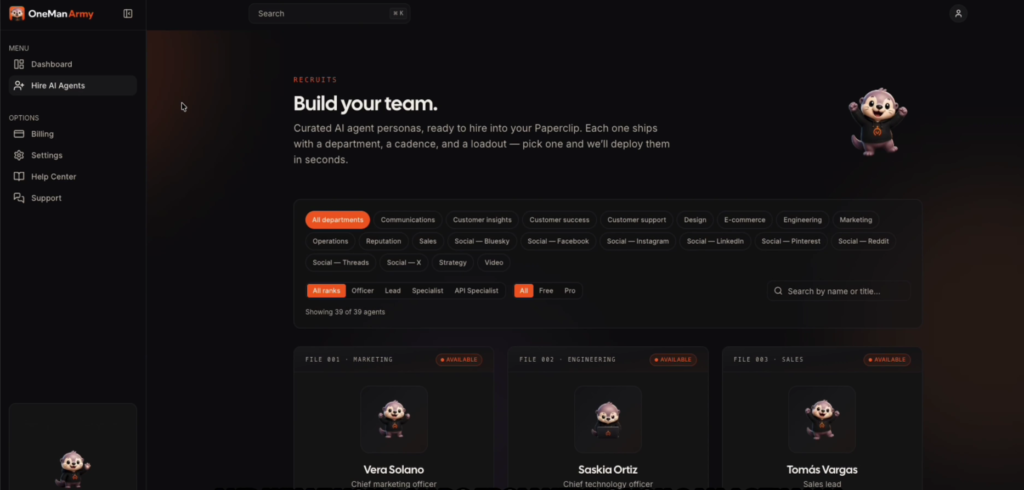
6. AI Agent Library
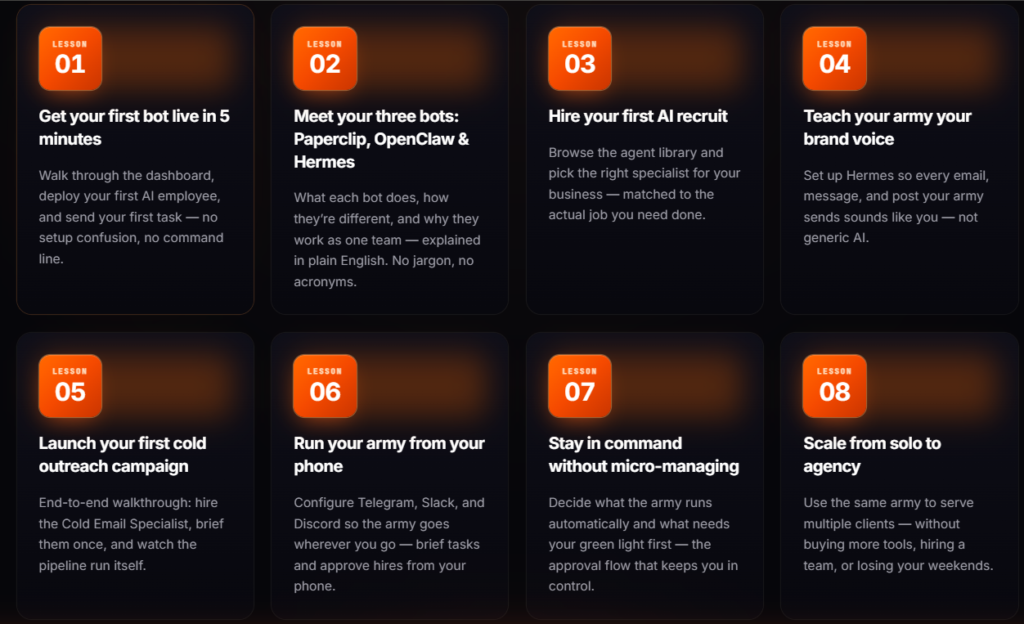
A growing roster of 39 pre-built specialist agents — cold email writers, SEO specialists, social media managers, video script writers, and more. You browse the library, pick a role, and click hire. The agent joins your Paperclip team with instructions already built in. New agents are added monthly.
7. Fully Hosted Platform
No Docker, no VPS, no API key hunting. The entire infrastructure is managed by the OneManArmy team. Your instance is cloud-hosted, browser-accessible, and isolated. One year of hosting is included with the front-end purchase; $67/year to renew after that. Complimentary API access is bundled so you don’t need to set up provider accounts on day one.
8. Commercial License
Included with the front-end purchase. You can use outputs for clients and run a service business off the platform from day one. This is standard for JVZoo tools but worth confirming — yes, it’s genuinely included.
What I Liked
- The hosted setup actually solves a real problem. If you’ve ever spent a weekend trying to self-deploy these tools, you know the friction is real.
- Hermes’s persistent memory is the standout feature. Not having to re-brief your AI on every session saves significant time over a week.
- The dashboard is clean, well-organized, and genuinely more polished than most JVZoo product interfaces.
- The Telegram/Discord integration works smoothly and makes the platform practical for mobile-first users.
- The AI agent library gives you 39 pre-built specialists to deploy immediately — useful for getting value quickly.
- One-time pricing at $47 is reasonable compared to paying $20–30 per month per individual AI tool.
- The training modules are beginner-friendly and walk through the actual platform rather than generic AI theory.
What I Didn’t Like
- The marketing is aggressive. The sales page leans hard into income potential and lifestyle framing that oversells what the software does. The “billion-dollar solo company” angle is compelling copy — it’s not a product promise.
- There’s still a meaningful learning curve. Getting value from the platform requires understanding how to prompt each bot effectively, how to structure goals in Paperclip, and how to connect the three systems. That takes more than a quick training module.
- The upsell stack is significant. Four OTOs between $67 and $197 adds up fast. The front-end is usable on its own, but some features you might expect — like more than 2 active bot deployments — require upgrading.
- Editing is still required. Every output I got needed human review and often substantial editing before it was ready to use. Anyone expecting polished, client-ready copy on the first pass will be frustrated.
- The bots don’t coordinate automatically. You’re the integration layer between Paperclip, OpenClaw, and Hermes. They run in parallel, but they don’t hand tasks between themselves without your direction.
You may also like : OmniVisual Review : 7 Mind-Blowing Benefits of This Next-Level AI Visual Engine
OneManArmy OTOs & Pricing
| Package | Price | What You Get |
|---|---|---|
| Front-End | $47 (one-time) | Hosted dashboard, 2 bot deployments, 1 month API access, commercial license, 1 year hosting |
| OTO 1 — Pro | $67 | 5 bot instances, full skill library, custom skill training, 6 months of bot updates |
| OTO 2 — Persona | $67 | Pre-built AI employee library, 10 done-for-you AI company setups (1-click import) |
| OTO 3 — Agency Platinum | $97 | Done-for-you agency website, proposal templates, agency license, extra hosting + API access |
| OTO 4 — Reseller | $197 | 25 reseller accounts, keep 100% of profits, reseller playbook included |
| Full Bundle | $347 | Everything above in one package (saves $128 vs buying separately) |
A few things worth noting. The front-end includes 2 bot deployments — if you want all three active simultaneously, you’ll need the Pro upgrade. The complimentary API access covers one month at the front-end tier; after that, you bring your own key or upgrade to extend it.
Most beginners should probably start with the front-end version first. Test it for a couple of weeks before deciding whether the upsells make sense for your workflow. The OTOs are real product expansions, not padded filler, but they’re only worth buying if you’re actually going to use the features.
Is OneManArmy Scam?
No. The software exists, the dashboard works, and the infrastructure is real. Paperclip, OpenClaw, and Hermes are genuine open-source AI projects with substantial community followings — you can verify the GitHub stars and OpenRouter rankings independently. OneManArmy didn’t invent these bots; they built a hosted platform around them, which is a real and legitimate service.
That said, the marketing does what aggressive JVZoo marketing does — it amplifies the possibilities and softens the limitations. The platform won’t run your business for you. It won’t generate income while you sleep. And it won’t replace the need for human thinking, editing, and strategy.
The question isn’t whether it’s a scam — it isn’t. The question is whether it matches your expectations going in. If you understand it’s a productivity tool that saves time on drafting and research tasks, you’ll get genuine value. If you expect automation to do the heavy lifting, you’ll be frustrated.
The 14-day money-back guarantee with no stated conditions is a reasonable safety net. Use it to actually test the platform before that window closes.
Who Should Buy OneManArmy?
Recommended for:
- Affiliate marketers who need to move faster on content research, comparison articles, and email sequences
- Freelancers looking to handle more client work with AI-assisted drafting and research
- Agency owners who want to scale output without hiring additional team members
- Anyone who has tried to self-deploy Paperclip, OpenClaw, or Hermes and gave up on the technical setup
- AI enthusiasts who want to explore multi-agent workflows without needing a developer background
Not ideal for:
- Complete beginners expecting passive income or hands-off automation
- Users who need fully polished, client-ready output without any editing
- Anyone who wants the three bots to coordinate automatically without human direction
- People who aren’t willing to invest time in learning how to prompt effectively
OneManArmy Alternatives
| Tool | Strengths | Limitations |
|---|---|---|
| ChatGPT Teams | Familiar, polished UI | No agent orchestration; no memory between projects |
| Claude Projects | Strong long-context memory | Single model, no multi-agent workflow |
| Flowise AI | Visual node-based builder | Self-hosted, requires technical setup |
| AutoGen | Powerful multi-agent framework | Developer-only; no hosted option |
| CrewAI | Strong role-based agents | Requires Python knowledge to configure |
| LangFlow | Good for visual workflows | Setup complexity, no commercial license bundled |
| OneManArmy | Hosted, no-code, three bots in one | Marketing hype; editing still required |
The main differentiator for OneManArmy is simplicity and hosted deployment. Tools like Flowise, AutoGen, and CrewAI are more powerful in certain respects but require meaningful technical setup. ChatGPT Teams and Claude Projects are polished but single-model — they don’t give you multi-agent orchestration. OneManArmy sits in an interesting middle ground: accessible enough for non-developers, substantive enough to be genuinely useful.
Final Verdict — Is It Worth It?

After four days of testing, my honest OneManArmy review verdict is this: it’s more interesting than most JVZoo launches, and the underlying concept is solid.
The hosted infrastructure is a legitimate solution to a real problem. The three-bot stack — Paperclip for planning, OpenClaw for execution, Hermes for memory — is a thoughtful architecture that reflects how serious AI operators are actually working in 2026. The fact that it’s built on real open-source projects rather than proprietary AI wrappers gives me more confidence in the platform’s longevity.
The marketing, however, oversells the product significantly. This is not a business in a box. It’s a productivity platform that makes you faster at certain tasks. That’s genuinely valuable — it’s just a different thing from what the sales page implies.
At $47 for a one-time payment, with 14 days to test it properly, the risk is low. If you go in with realistic expectations — AI workforce assistant, not AI autopilot — you’ll likely find it useful. If you’re a freelancer, agency owner, or affiliate marketer who spends hours every week on research and content drafts, the time savings can easily justify the cost.
My Rating: 7.5/10 — A legitimate AI platform with real utility, held back slightly by aggressive marketing and a meaningful learning curve.
Frequently Asked Questions
Does OneManArmy require any coding?
No. The platform is entirely browser-based with no terminal access, Docker, or code editing required. The three-question setup wizard handles configuration, and all bot management is done through the dashboard UI.
Is it beginner-friendly?
It depends on your definition of beginner. The technical setup is genuinely beginner-friendly — no coding, no servers, ready in five minutes. But getting meaningful output requires understanding how to prompt the bots effectively and how to structure goals in Paperclip. The Operator’s Academy training helps, but expect a week or two before you’re fully comfortable.
Does it include commercial rights?
Yes. A commercial license is included with the front-end purchase. You can use platform outputs for client work and run an AI services business from day one.
Is it a one-time payment?
The front-end is a one-time payment of $47 at launch pricing. After the launch window closes, the platform is expected to move to a monthly subscription model — so buying now locks in the one-time rate. Annual hosting renewal after year one is $67/year.
Can OneManArmy fully automate a business?
No. And any platform that claims it can is overselling. OneManArmy can help you move faster on drafting, research, planning, and content creation tasks. But it requires active direction, prompt crafting, and human editing to produce usable output. Think of it as a force-multiplier, not an autopilot.
Does it support Telegram and Discord?
Yes. Both Telegram and Discord (plus Slack) can be connected directly from the OneManArmy dashboard without terminal access or .env file editing. Once connected, you can brief agents, receive updates, and approve actions from your phone.
This review was written based on direct use of the platform. Results will vary based on use case, effort, and expectations.