
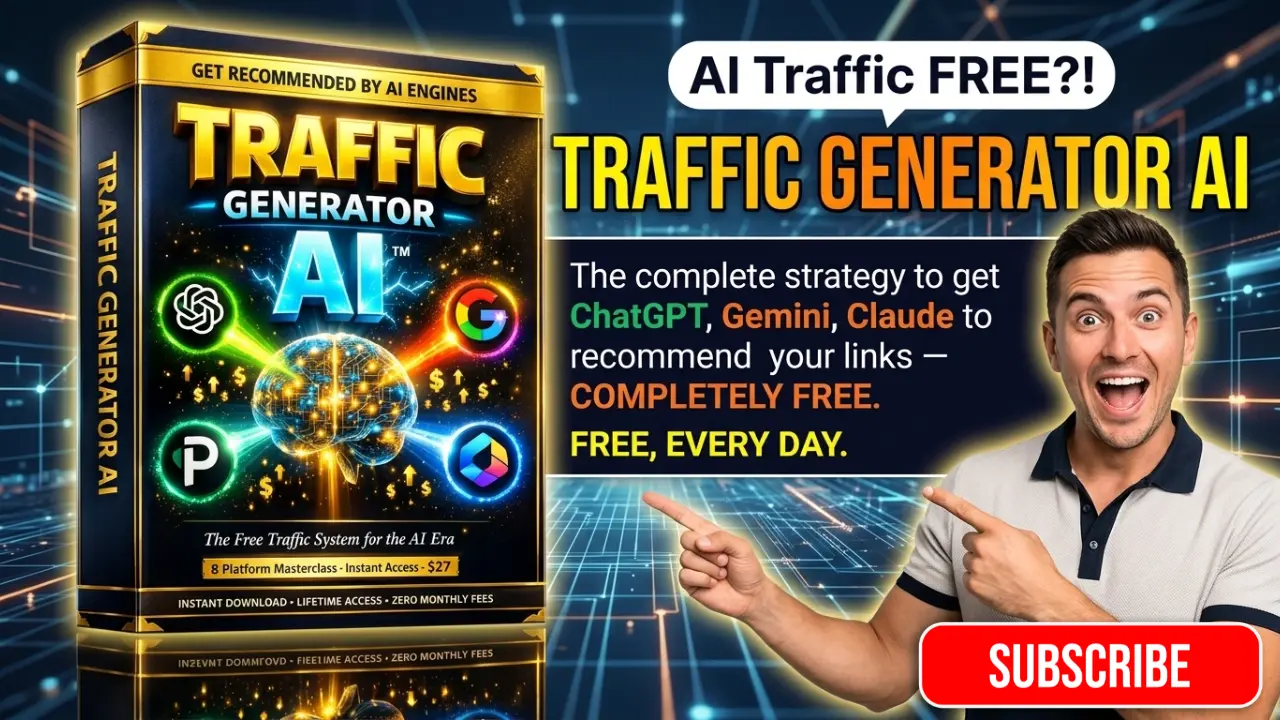

Traffic Generator AI Review 2026: Can AI Replace Google Traffic?
Introduction: The Search Engine Is No Longer the Gatekeeper
Something quietly shifted in 2025 — and if you haven’t noticed it yet, your traffic numbers probably have.
Millions of people stopped typing queries into Google and started asking ChatGPT, Perplexity, and Gemini instead. They’re not just asking casual questions either. They’re asking things like “What’s the best email marketing tool for beginners?” and “Which affiliate program pays the most?” — and AI tools are responding with specific recommendations, links, and actionable answers.
That’s a fundamental change in how buyers find products and services online.
For marketers, content creators, and business owners, this creates both a threat and a massive opportunity. The threat? If you’re still betting entirely on Google SEO, you may be invisible to a growing segment of your audience. The opportunity? The AI traffic window is still wide open — and most marketers haven’t stepped through it yet.
This Traffic Generator AI Review will walk you through everything you need to know about the course, the strategy behind it, and whether it’s worth your time and money in 2026.
You may also like : Solo Ads Freedom Stack Review: 4 Secrets to Making Money With Solo Traffic
What Is Traffic Generator AI?
Traffic Generator AI (TGA) is a digital training program built around one core idea: getting AI tools like ChatGPT, Google AI, and Perplexity to recommend your content, links, and offers — completely free, without running a single ad.
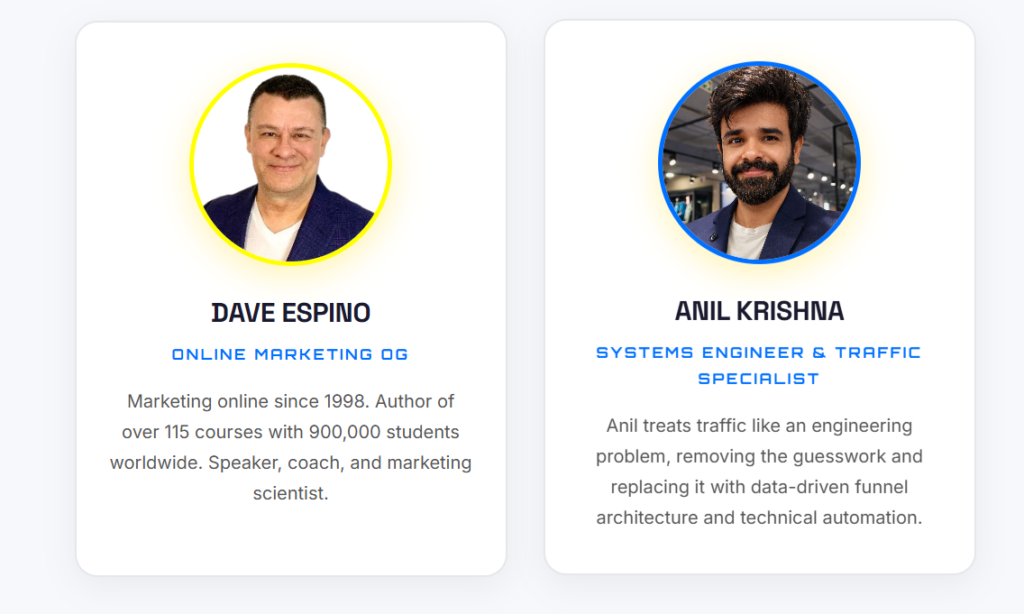
The program was created by Dave Espino, a veteran online marketer with over 25 years of experience and more than 115 courses under his belt, and Anil Krishna, a systems engineer who approaches traffic generation like an engineering problem — data-driven, structured, and repeatable.
Together, they’ve built a step-by-step system that teaches you how to place content across eight specific platforms in a way that AI engines actively pick up, index, and cite when users ask relevant questions in your niche.
It’s not about going viral. It’s not about gaming an algorithm with tricks. It’s about showing up in the right places, in the right format, so that AI tools naturally surface your content as a trusted recommendation.
In simple terms: Traffic Generator AI teaches you to get free traffic from AI search — before the crowd figures out it’s possible.


What Is GEO (Generative Engine Optimization)?
If you’ve been in the SEO world for a while, you’re familiar with optimizing content for search engine crawlers. GEO takes that concept and applies it to a new generation of tools.
Defining GEO
GEO stands for Generative Engine Optimization. It refers to the practice of structuring and distributing content in a way that makes it more likely to be cited, referenced, or recommended by AI-powered search engines and large language models.
Where traditional SEO focuses on ranking in a list of blue links, GEO focuses on being the answer that an AI tool actually generates and surfaces to a user.
How GEO Differs From SEO
| Factor | SEO | GEO |
|---|---|---|
| Goal | Rank on page 1 of Google | Be cited in AI-generated answers |
| Timeline | 3–12 months | Days to weeks |
| Content format | Keyword-rich pages | Clear, useful, structured content |
| Technical requirements | High (backlinks, authority, speed) | Low (clarity and usefulness win) |
| Platforms | Mainly your own website | Multiple external platforms |
Why GEO Matters in 2026
AI search is no longer experimental — it’s mainstream. Google’s AI Overviews, ChatGPT’s browse mode, and Perplexity’s citation-based answers are now part of how hundreds of millions of people get information every day.
If your content isn’t structured for AI readability, you’re simply not part of the conversation. GEO marketing is the strategy that puts you back into it.
Key Takeaway: GEO doesn’t replace SEO — it extends it into a new channel that’s growing faster than any other traffic source right now.
How AI Traffic Actually Works
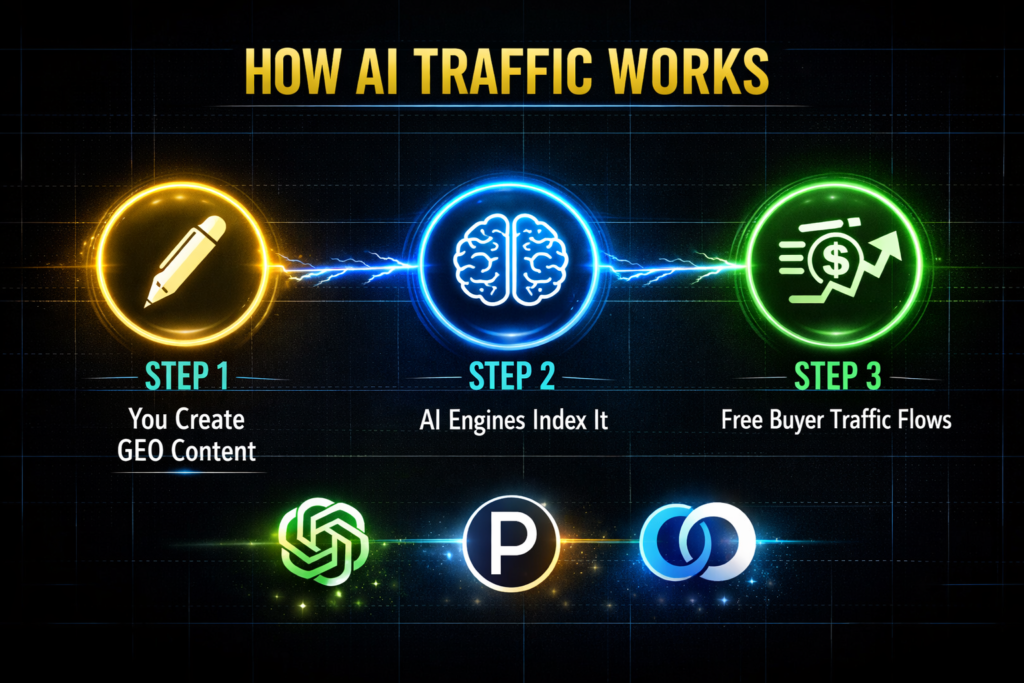
Understanding the mechanics of AI search traffic helps you see why this strategy makes sense rather than just taking someone’s word for it.
How AI Engines Discover Content
AI tools like ChatGPT and Perplexity don’t crawl the web the same way Google does. They pull from large indexed databases, training data, and — in the case of tools with live search — from platforms they’re specifically configured to read from.
Certain platforms carry more weight than others. High-authority publishing sites, active Q&A communities, video transcripts, and professional networks are all regularly read and indexed by AI engines.
The Recommendation System
When a user asks an AI chatbot a question, the tool doesn’t randomly pick an answer. It looks for content that is:
- Clear and specific — vague content gets passed over
- Structured and well-formatted — lists, steps, and headers are easier for AI to parse
- Published on credible, indexed platforms — domain authority still matters
- Relevant to the exact question — topical depth is rewarded
If your content checks these boxes and lives on the right platforms, AI tools are far more likely to surface it in their responses.
Why This Works Without Ads
Traditional paid traffic stops the moment your budget runs out. AI-cited content, on the other hand, compounds. A post on a high-authority Q&A platform can generate citations for years after it’s published — with zero additional cost.
This is the core promise behind the AI traffic strategy taught inside Traffic Generator AI.
You may also like : BullRush Traffic Review + 30% Offer + OTOs+ Bonus $43k
Key Features Breakdown
Here’s what you actually get inside the program:
8 Platform Playbooks
The heart of Traffic Generator AI is a detailed breakdown of eight specific platforms that AI engines actively pull from. Each playbook walks you through exactly how to publish on that platform, what format to use, and how to position your content for maximum AI visibility.
The platforms span Q&A sites, long-form publishing platforms, professional networks, video hosting, and visual discovery engines — a diversified mix that covers multiple AI engines simultaneously.
The AI Visibility Blueprint
This is TGA’s strategic framework — a repeatable system for structuring content so it stands out to AI tools. It’s not just about what you write, but how you format it, where you publish it, and how you connect it all together for a compounding effect.
Ready-to-Use AI Prompts
One of the most practical additions in the program. These prompts let you drop your niche into a template and generate AI-optimized traffic assets without having to figure out what “GEO-ready content” even looks like from scratch.
The “Are You Showing Up?” Check
This module gives you three simple ways to verify whether your content is actually being picked up by AI tools. Most marketers publish and hope — this system lets you confirm it’s actually working.
Done-For-You Asset Templates
Pre-built templates for all eight platforms, already structured in the GEO format that AI engines favor. You fill in your niche and offer — the format and structure are handled for you.
Two Bonus Items
- GEO Content Templates — Expands the template library with platform-specific formats already optimized for AI citation
- FB Group Poster Tracker — An Excel-based tracking system for managing Facebook group posting, including post scheduling, group performance tracking, and DM follow-up sheets
My 4-Day Experience With Traffic Generator AI
I went through the program over four days and want to give you an honest breakdown of the experience.
Day 1 — Orientation and Mindset Shift
The first day was about understanding the core concept. If you’ve been doing traditional SEO for years, there’s a mental adjustment required. You’re not optimizing for a crawler — you’re publishing for readers and AI readers simultaneously.
The explanation of how AI engines discover and cite content was the clearest I’ve seen it laid out. No fluff, no overhyping — just a logical walkthrough of the mechanism.
Day 2 — Platform Research and Setup
Day two involved reviewing the eight platform playbooks. Some platforms I was already on, which made it easier to see how to reposition existing content. Two of the platforms were genuinely new discoveries for me in the context of AI traffic.
The learning curve is low. If you can write a paragraph and create a free account, you can follow the playbooks.
Day 3 — Content Creation With AI Prompts
Using the included AI prompts, I put together content for three of the eight platforms. The prompts are genuinely useful — they take the guesswork out of format and structure. This is where beginners will save the most time.
Day 4 — Publishing and Tracking
By day four I had content live on three platforms and was using the verification method from the “Are You Showing Up?” module. Early results were visible on one platform within 48 hours of publishing — AI tools were already indexing the content.
It’s worth noting that the program is honest about the timeline: meaningful, compounding traffic typically develops over four to eight weeks of consistent posting. Day four is the start, not the finish line.
Pros and Cons
Advantages
- Genuinely ahead of the curve. Most marketers are not doing this yet. Early movers have a real advantage.
- Low barrier to entry. No website, no technical skills, and no ad budget required.
- Practical templates and prompts. You don’t start from zero — everything is ready to use.
- Multi-platform approach. Spreading across eight platforms gives you exposure to multiple AI engines, not just one.
- Honest about expectations. The program explicitly states this takes four to eight weeks of consistent effort. That kind of transparency is rare in the info-product space.
- Lifetime access. One payment covers all future updates as the strategy evolves.
Limitations
- Requires consistency. This is not a one-click solution. You need to post regularly across platforms for the traffic to compound.
- Results vary by niche. Competitive niches may take longer to gain traction.
- Platform dependency. If one of the eight platforms changes its policies or falls out of AI favor, that piece of the strategy weakens.
- No live community mentioned. A mastermind group or support community could add significant value for accountability and Q&A.
You may also like : TrafficGram AI Review 2025 – Complete Expert Analysis Before You Buy
Final Verdict: Is Traffic Generator AI Worth It?
At $17, the question of value is almost not worth asking. The framework alone — understanding that GEO marketing exists, how AI tools discover content, and which platforms to prioritize — is worth multiples of the price.
Who should buy this:
- Affiliate marketers looking for free, compounding traffic
- Beginners with no website or audience who want a clear starting point
- Content creators who want their existing work to do more
- Experienced marketers who want to diversify beyond Google and paid ads
Who should pass:
- Anyone expecting instant results without consistent effort
- Businesses looking for a fully managed, hands-off traffic solution
The strategy is real, the opportunity is real, and the window is genuinely open right now. If you’re curious about AI search traffic and want a structured, no-fluff roadmap, Traffic Generator AI delivers exactly that.
Frequently Asked Questions
Is GEO replacing SEO?
Not entirely — but GEO is rapidly growing in importance alongside SEO. As AI tools handle more of the search experience, GEO is becoming an essential complement to traditional search optimization strategies.
What is GEO vs SEO vs AEO?
SEO (Search Engine Optimization) targets Google and Bing rankings. GEO (Generative Engine Optimization) targets AI-generated answers in tools like ChatGPT. AEO (Answer Engine Optimization) is a related term that focuses on getting your content cited as direct answers in any type of answer engine, including voice search.
What do SEO and GEO stand for?
SEO stands for Search Engine Optimization. GEO stands for Generative Engine Optimization. Both are strategies for increasing content visibility, but they target different discovery systems.
What is GEO in SEO AI?
In the context of AI, GEO refers to optimizing your content so that AI-powered tools — like ChatGPT, Perplexity, and Google AI — are more likely to surface it as a recommended answer when users ask relevant questions.
What is GEO marketing?
GEO marketing is the practice of creating and distributing content in formats and on platforms that AI engines actively index and cite. The goal is to have AI tools recommend your links, offers, or brand to users automatically — without paid advertising.
What is GEO vs SEO?
SEO optimizes for search engine rankings in tools like Google. GEO optimizes for AI-generated recommendations and citations. SEO relies heavily on backlinks and domain authority; GEO rewards clarity, structure, and platform selection.
What does GEO mean in AI marketing?
In AI marketing, GEO (Generative Engine Optimization) means structuring content so that AI tools like ChatGPT and Gemini will cite or recommend it when generating answers for users — effectively replacing the need for users to click through search results.
Is GEO part of SEO?
GEO is an evolution of SEO, not technically a subset of it. Both aim to increase content visibility and traffic, but GEO applies to an entirely different set of tools, platforms, and content formats.
What is geo marketing SEO?
The term combines two concepts: GEO marketing refers to AI-driven content visibility, while SEO refers to traditional search engine optimization. Together, it describes a blended strategy where content is optimized for both Google rankings and AI citation.
What are the 4 types of SEO?
The four core types of SEO are: On-page SEO (content and keyword optimization), Off-page SEO (backlinks and authority), Technical SEO (site speed, crawlability, structure), and Local SEO (geographic targeting for local businesses). GEO is increasingly considered a fifth emerging category.
How to do GEO SEO?
To practice GEO optimization, focus on publishing clear, well-structured content on high-authority platforms that AI engines actively index. Use concise formatting, answer specific questions directly, and distribute content across multiple platforms to increase the chances of AI citation.
Is GEO better than SEO?
Neither is universally better — they serve different purposes. SEO is still essential for long-term organic visibility on search engines. GEO is emerging as a faster path to AI-driven traffic, particularly for newer marketers without established domain authority. A combined approach typically delivers the best results.
Disclaimer: Individual results will vary based on niche, effort level, and consistency of content publishing. The review above reflects the author’s personal experience and is intended for informational purposes only.